Saturday, 22 June 2019

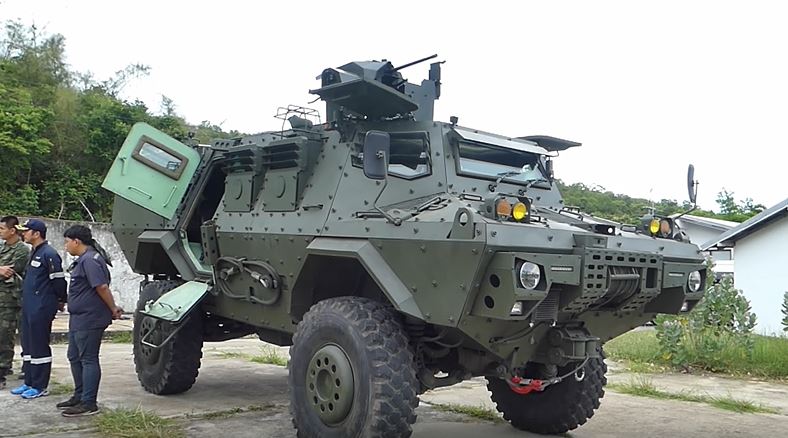
AFV-420P mounted SARP automatic turret system RCWS - YouTube

BATTLEFIELD DEFENSE

รถเกราะ AFV-420P ติดระบบป้อมปืนอัตโนมัติ SARP RCWS ทดสอบยิงครั้งแรก - YouTube


SARP automatic turret system RCWS

BATTLEFIELD DEFENSE

BATTLEFIELD DEFENSE
BATTLEFIELD DEFENSE
HMV-150 / HMV-420 / AFV-420P Mosquito 4×4 APC: Details

Volga-Dnepr dismisses court’s An-124 seizure order as unlawful

235FireFly

https://www.aircargonews.net/airlines/freighter-operator/volga-dnepr-dismisses-courts-an-124-seizure-order-as-unlawful/: 

The Volga-Dnepr group has dismissed a Ukrainian court’s order to seize five of its An-124-100 aircraft.

The Russia-headquartered airline group told Air Cargo News that it deems that the order of the Podolsky District Court of Kiev related to a ban on the use and operation of five An-124-100 civil aircraft of Volga-Dnepr Airlines as unlawful.

“Volga-Dnepr Group believes that the court order is fundamentally unsubstantiated so are the chances to enforce it in the foreign jurisdictions,” the company said.

“Volga Dnepr Airlines is fully authorised by the Russian aviation authorities for international flights without any restrictions. It complies with all international regulations governing civil aviation.

“All necessary actions will be taken to object the said order as well as to draw public attention, together with the attention of the international governmental institutions, to the current situation.”

The move comes after Ukraine-based law firm Ilyashev & Partners claimed that the Podilskyi District Court of Kiev had ordered the arrest and prohibited the operation of the aircraft on the grounds that maintenance checks have not been completed by an authorised entity.

The law firm also stated that third parties (airports, aviation authorities) are prohibited from carrying out any actions aimed at landing/take-off (arrival/departure) of the aircraft.

However, it is understood this is not legally binding.

The law firm said that checks had been carried out on the aircraft by Volga-Dnepr’s AMTES, but without the required participation of Antonov.

“According to SE Antonov, the investigations and the court, the admission of An-124 aircraft to further operation violates the provisions of the ICAO Convention on International Civil Aviation and Airworthiness Manual,” said Senior Partner of Ilyashev & Partners International Law Firm Roman Marchenko.

“The arrest of property is allowed to ensure the safe-keeping and integrity of physical evidence and compensation for damages caused by the criminal offence.”

The court order is related to RA-82068, RA-82078, RA-82045, RA-82046 and RA-82077.

Despite the order, two of the aircraft have continued to fly over recent days. RA-82077 has over the last few days called at Milan Malpensa, Denver, Columbus, Seattle and Mountain View, while RA-82046 has called Tunis, Stavanger, Novosibirsk and Johor Bahru.

In 2016, Antonov had threatened to apply for a ban on Volga-Dnepr flying the aircraft if it sought to move support functions for the aircraft out of Ukraine.

Given the ongoing conflict between Russia and Ukraine, this left Volga-Dnepr in a difficult position.

The two companies later that year decided to end a joint venture business that offered capacity on their combined fleet of An-124s.

An-124 Ruslan (Condor): Details

PARIS: Norway’s Boeing P-8 buy delivers Nammo ramjet shell deal

U.S. Army photo


PARIS: Norway’s Boeing P-8 buy delivers Nammo ramjet shell deal

Boeing has signed an agreement to help Nammo further develop ramjet-powered artillery shells.

The development deal is the result of an offset agreement with the Norwegian government related to the acquisition of five P-8A Poseidon maritime patrol aircraft by the Royal Norwegian Air Force in 2017.

Maria Laine, vice-president of international strategic partnerships for Boeing Defense, Space & Security, and Stein Erik Nodeland, executive vice-president of aerospace propulsion at Nammo, signed the "strategic agreement" at the show on 19 June.

Ramjet artillery work will be performed by Nammo's development team in Raufoss, Norway and by Boeing's Phantom Works advanced research division in St. Charles, Missouri. The total terms of the offset deal were not disclosed, although it is understood to have a 25-year duration.

Nammo expects to offer its ramjet-powered artillery shells to the international market by 2024. The country sees demand for the long-range precision weapons from the USA and its allies – in particular, the US Army, which has set deep-penetration artillery as one of its top six priorities in the light of longer range Russian weapons.

Nammo aims to add a solid fuel ramjet to a 155mm artillery shell, a modification it believes could propel the munition up to 62m (100km).

155 mm Nammo ammunition: Details

Thursday, 20 June 2019

NATO to replace its E-3A by new E-7 AWACS surveillance aircraft

The growing Lockheed mystery: Why is US in a rush to push F-21 to India?

Lockheed Martin

The growing Lockheed mystery: Why is US in a rush to push F-21 to India?: 

The F-21 seems to be an offshoot of the single-engine F-16 multi-role fighter.

More than 50 years ago, the then Soviet Union gave the latest MiG-21 fighter to a beleaguered Indian Air Force. Two decades later, in the early 1980s, the United States gave a “state-of-the-art” latest General Dynamics-manufactured multi-role F-16 fighter to Pakistan despite Indian Prime Minister Indira Gandhi's objections. However, it all began earlier, when both US President Richard Nixon and his aide Henry Kissinger hated the Indian Prime Minister's guts which were amply demonstrated to the world in the December 1971 Bangladesh war. Not surprisingly, the US supplied the best of its fighters to Pakistan and snubbed India.

India faced several crises since 1947 but the striking feature of these is that New Delhi weathered all of them without ever using American fighters till date. India only used British (De Havilland Vampire, Hawker Hunter, English Electric Canberra), French (Ouragon aka Toofani, Mystere, Mirage-2000 and now Dassault Rafale), Russian (MiG-21, 23, 25, 27, 29; Sukhoi-7, 30MKI) and Anglo-French (SEPECAT) Jaguar strike aircraft.

Though times have changed, there does not seem to be any sign of an imminent entry of US fighters into an Indian Air Force squadron service. And this must be what has been bothering the US President and his team. Of late, signs of desperation appear to have been be the reason behind “browbeating”  India: “Buy our equipment. Do not buy Iranian oil. Buy US-made fighters. Do not buy a Russian-made missile defence system. Or else…!” The superpower seems to be going overboard. But why?

A few years ago, the US Lockheed Martin F-16 could not make the grade through open competition between six bidders. And now suddenly the US wants the F-21, which is being touted as the successor of, and superior to, the F-16, to be bought by India! How? Through US “foreign military sales”  (FMS). Through, “government-to-government transaction” as is being done in the Middle East. Will it be fair on the part of the US to compel New Delhi to get a bad name? As it is, there is no end to the list of defence scandals in India. Why then is the US pressuring India by every means?

Seen in this background, the growing buzz and the media blitz over the Lockheed Martin F-21 being offered to India made this columnist turn the pages of the last 40 years of the annual edition of Jane’s All the World’s Aircraft to learn afresh the history of the appearance of this unseen and unknown fighter aircraft. As one had neither heard, nor seen any reference to this “state-of-the-art” fighter ever before — one thought that the very name F-21 may be an extremely lethal aerial platform — implying it as “the fighter of the 21st century”.

After almost four weeks, one found no reference of the F-21 in any aviation book. But then, if a mega-fighter aircraft contractor like Lockheed Martin makes a proposal for the Indian Air Force, there must be something in it. Else, Lockheed Martin may lose credibility and its customer base in an era of sluggish market demand and fierce competition amongst multiple manufacturers chasing a shrinking consumer base.

Coming back to the “actual” F-21! What exactly is it? Wherefrom has it been derived? How long will it take to fly, from “the drawing board to squadron service”? From whatever has trickled in thus far, the F-21 seems to be an offshoot of the single-engine F-16 multi-role fighter. “Tailor-made”, primarily, for exclusive Indian Air Force requirements and secondarily, to be exported by India, as Lockheed Martin has in mind shifting its entire production line and technological knowhow to India as a joint venture with a local company.

That all sounds like music to India's ears, no doubt. Nevertheless, it raises more questions than give any answers. In what way will the F-21, not a single prototype of which has been produced yet, be the ideal choice for the Indian Air Force? Is the choice of a fighter aircraft the sovereign right and decision of the Indian Air Force and the Government of India, or a foreign contractor's imposition?

Is not the Indian Air Force the sole institution responsible for specifying its own requirements, stipulate as to how it would operate its fighters; against what sort of adversaries and in what operational environments?

Not a single Air Force in the world is using the Lockheed Martin F-21 because it has not yet been produced. Hence, the puzzle: Where do we start from? From the F-16? But then, the F-21 is reportedly different from, and superior to, the F-16! Nevertheless, if the Indian Air Force is to choose the F-21 and nothing else, then the best option, at present, would be to scan through the specifications of the latest version of the F-16 — to at least have an idea.

But here again is the old dilemma. Did not the Indian Air Force reject the F-16 only the other day while selecting its medium multi-role combat aircraft, from amongst six bidders, including the US Boeing twin-engine F-18; the Russian twin-engine MiG-35; the Eurofighter twin-engine Typhoon; the French Dassault twin-engine Rafale and the Swedish single-engine Saab Gripen? So, what changed?

According to Jane’s All the World’s Aircraft 2018-2019: “4,588 F-16” fighters so far have been delivered to 24 users, included in which are the US Air Force and Navy, and the last F-16C (block 50) was reportedly delivered to Turkey in May 2011. Thus, eight years have passed for the F-16 without any sale/order.

Understandably, “in March 2017, it emerged that Lockheed Martin planned to cease manufacture of the F-16 at Fort Worth, Texas, in order to devote more resources to the (single-engine) F-35 Lightning II. The last F-16 to roll off the Fort Worth line in September 2017, whereupon the company will transfer equipment tooling to its plant at Greenville, South Carolina, which is to assume responsibility for the F-16.” — Jane’s 2018-19.

In other words, the F-16’s days are over. It’s got to be reborn. What better place for a rebirth than in India? If indeed Lockheed is serious about the F-21, then it should declare the broad improvements (without divulging its trade secrets and militarily sensitive info) for India to consider. As is well known, there are approximately 20 parameters to be looked at in an aircraft, and compared with the competing craft. These are: “type; programme; (past) users, if any; costs; design features; flying control; structure; landing gear; power plant; accommodation; systems; avionics; armament; dimensions (external); wings; areas; weights and loading; max take off weight; payload; performance; range; and radius of operation”. One can only hope that the F-21 clears this examination!


Lockheed Martin Deletes Claim That Its Rebranded F-21 Could Be A Path To Indian F-35s

Paolo Thaon di Revel Launched - YouTube


Varata nave Paolo Thaon di Revel - YouTube


June 15, 2019 (Google Translation) – Paolo Thaon di Revel , Grande Admiral and Duca del Mare (1859-1948), creator of the victory over the sea in the Great War, as well as convinced promoter of the interforce collaboration. A man of action, often at the forefront and, at the same time, a supporter and promoter of knowledge as a tool for creating the future. From today his name stands out on the side of the new unit of the Navy fleet: the first, and headmaster, of seven Multivalent Offshore Patrolmen , launched today, Saturday 15 June, at the Fincantieri plant in Muggiano, near La Spezia. Source: seawaves.com


PPA Class Multi-purpose Offshore Patrol Vessels: Details

Wednesday, 19 June 2019

Royal Thai Air Force Becomes First International Customer for T56 Engine Upgrade

RTAF C-130H-30 #60111 from 601 Sqn is seen departing from Bangkok Don Mueang International Airport sometime during September 2013. [Photo by Tomas Naprstek] Via c-130.net

Royal Thai Air Force Becomes First International Customer for T56 Engine Upgrade | DOM Magazine

Rolls-Royce announces the Royal Thai Air Force as the first international customer to update its C-130H transport fleet with the Rolls-Royce T56 Series 3.5 engine upgrade. 

The technology upgrade has achieved considerable success with the U.S. Air Force C-130 and National Oceanic and Atmospheric Administration (NOAA) P-3 fleets. The Series 3.5 upgrade allows T56 engines to operate at greatly reduced temperatures, extending parts' life and improving reliability by 22 percent. It is available for installation on T56 engines powering either C-130 or P-3 legacy aircraft.

The Series 3.5 upgrade will help the Royal Thai Air Force to reduce operational costs due to reduced maintenance requirements and potential fuel savings exceeding 12 percent. It will also enable the fleet to remain in service until at least 2040.

Paul Craig, Rolls-Royce, president of Defence Services, says, “Rolls-Royce is pleased to secure the Royal Thai Air Force as our first international customer for the T56 Series 3.5 upgrade. The Series 3.5 package has already proven itself with the U.S. Air Force, and we are pleased that the Royal Thai Air Force will now be able to benefit from the improved fuel economy and enhanced performance and reliability that this upgrade offers.”

The first phase of the upgrade involves upgrading 20 engines from a total fleet of 58 engines over the next three years. The Series 3.5 technology, which is based on proven advances from other Rolls-Royce engines, can be added during regular overhauls to reduce cost and requires no changes to the aircraft or controls.

The Royal Thai Air Force selected Segers Aero Corporation in the U.S. to conduct the upgrade program following a competitive and comprehensive tender process. Segers Aero Corp is a Rolls-Royce Authorized Maintenance Center (AMC) and will be providing training, tooling, technical support, capability development and field-service support in conjunction with the engine-upgrade schedule.


RTAF C-130H #60108 take off from Joint Base Elmendorf-Richardson, Alaska on August 14, 2015. [USAF photo by Alejandro Pena] Via c-130.net

Rolls-Royce T56 Series 3.5 engine upgrade


aerotime.aero

Rolls-Royce has delivered the first T56 Series 3.5 engine upgrade kits to the US Air Force as the service introduces the improvements to its C-130H transport fleet. The Series 3.5 engine upgrade kits are already demonstrating success in a Hurricane Hunter WP-3D aircraft of the US National Oceanic and Atmospheric Administration (NOAA), with fuel savings exceeding 12% and improved range and payload capability. 


NOAA flight data also shows significantly lower turbine temperatures, improved high-altitude performance and much faster engine starts. USAF and US Air National Guard C-130Hs will begin receiving the T56 engine upgrades, starting with Air National Guard units in Wyoming and New York State. The Air Force has awarded a US$36m contract to launch the Series 3.5 upgrades into the fleet. The Series 3.5 upgrade, which was designed and funded by Rolls-Royce, allows T56 engines to operate at greatly reduced temperatures, extending parts life and improving reliability by 22%. The upgrades also provide improved “hot and high” performance. The Series 3.5 package can be installed on T56 engines on either C-130 or P-3 legacy aircraft. Source: c-130hercules.net


Omar Hayat Khan @behance.net

fi-powerweb.com