Saturday, 28 November 2020

Russia's newest corvette conducts the first launch of cruise missile off Pacific coast


Russia's newest corvette conducts the first launch of cruise missile off Pacific coast - Naval News

By Dorian Archus -November 26, 2020


The latest corvette of Project 20380 (Steregushchiy-class), Aldar Tsydenzhapov, built for Russia’s Pacific Fleet conducted its first launch of an Uran cruise missile against a naval target in the Peter the Great Gulf in the Primorye Region, the Fleet’s press office reported on 25th November.

“The cruise missile successfully struck the surface target at a distance of about 40 kilometers from the warship at the designated time. Up to 10 ships and vessels, and also aircraft of the Pacific Fleet’s naval aviation were involved in the test-fire to provide security in the area and exercise control of the results of accomplishing the combat assignment,” the press office said in a statement.

The latest corvette fired the cruise missile as part of the shipbuilders’ and state trials. In the evening of November 24, the warship held a series of artillery firings in the Sea of Japan, in which it delivered fire against a sea ship screen from a 100mm A-190 multi-purpose artillery gun, the statement says.

The Project 20380 third corvette Hero of the Russian Federation Aldar Tsydenzhapov developed by the Almaz Central Design Bureau of Marine Engineering (St. Petersburg) is designed to accomplish green-water missions, fight enemy surface ships and submarines and provide artillery support for amphibious assault operations.

The corvette incorporates the latest solutions for reducing its physical fields. In particular, the shipbuilders significantly reduced its radar signature during the construction, using radio absorption materials and specially designing the ship’s hull and superstructure.

Project 20380 ships are armed with multi-purpose artillery guns, surface-to-air missile/artillery systems, supersonic missiles and automatic artillery launchers. The Project 20380 corvettes can carry a Ka-27 helicopter. They displace 2,200 tonnes and have a crew of 99.

The corvette Aldar Tsydenzhapov is set to be accepted for service in Russia’s Pacific Fleet until the end of this year.


Project 20380 Steregushchy Class Corvettes: Details

Friday, 27 November 2020

Navy’s F/A-18 Super Hornets, other military planes not quite mission-ready, federal officials say

Alex Jossi


Navy’s F/A-18 Super Hornets, other military planes not quite mission-ready, federal officials say - The Virginian-Pilot - The Virginian-Pilot

By DAVE RESS
DAILY PRESS |
NOV 24, 2020 AT 1:22 PM

FILE- In this May 16, 2019 file photo, released by the U.S. Navy, an F-18 Super Hornet is launched from the deck of the USS Abraham Lincoln aircraft carrier in the Arabian Sea. For decades considered a U.S. national security priority, the Persian Gulf remains home to tens of thousands of American troops spread across sprawling bases protecting crucial routes for global energy supplies. But while U.S.-Iran tensions in the Gulf appeared close to sparking a global conflagration this summer, attention now rapidly has shifted to Syria. (Mass Communication Specialist 3rd Class Jeff Sherman, U.S. Navy via AP, File)


Key U.S. military aircraft, including some of the most common ones flown around Hampton Roads, have for years been missing goals for their readiness to fly missions, the U.S. Government Accountability Office reports.

The agency said the Navy’s F/A-18E and F Super Hornet fighter jets, its E-2C Hawkeye early warning aircraft and C-2A cargo planes did not meet annual goals for the total time they can fly and perform their mission at any time between fiscal years 2011 and 2019.

The Air Force’s F-22 Raptors also missed their annual goals for all of those years.

The Navy’s E-2D Advanced Hawkeye, which is to replace the E-2C, missed its goal in each of the six years since its introduction. Navy F/A-18A-D Hornets met their goal once in the nine-year period.

“The average annual mission capable rate for the selected Air Force, Navy, and Marine Corps aircraft decreased since fiscal year 2011,” the GAO said.

Analysts inside and outside the military have warned for years that a shortage of people and replacement parts could affect air operations and make the aircraft less safe.

The GAO’s review of 46 military aircraft found that only one, the Air Force’s UH-1N Huey, reached its goal every year. Most missed their goals a majority of the time, with 24 never making the target and five hitting their goals only once.

For the Navy’s workhorse F/A-18E and F, with an average age of 12 years and time aloft averaging 3,526 hours, unexpected repairs, parts shortages and components that are no longer useful or are no longer being made were significant problems, GAO reported.

Maintenance costs account for $700 million of the Super Hornet’s $3.29 billion annual operating cost in fiscal year 2018.

The Navy has a contract with Boeing to extend the service life of the Super Hornet from 6,000 to 10,000 hours through modifications, but that comes with big maintenance cost increases since several life-limited components require replacement at 6,000 flight hours,

The Navy’s older F/A-18A-D fighters, with average ages of more than 27 years and an average of 7,585 hours in the air, are operating beyond their planned service life. The Navy aims to address the maintenance and supply challenges that come with that by allowing maintainers to work overtime to reduce backlog, and streamlining repair processes, GAO said.

For the other fighter jets regularly seen in Hampton Roads skies, the Air Force’s F-22, the systems and structures that make the planes harder to detect and spare parts shortages have been challenges, GAO said.

Maintenance costs rose from $1.04 billion to $1.59 billion between 2011 and 2018, GAO said, citing constant increases in contractor support costs.

The Air Force is contracting to increase repair capacity for those “low observable” systems and structures and is securing additional funding for spare parts.

Besides fighters, the other Navy planes vital to carrier operations are also aging.

The E-2C planes, some of which are 30 years old, are also operating beyond planned service life, while demand for the limited number of these aircraft keep them in the air a lot.

And the E-2D slated to replace it also faces maintenance and supply challenges, which the Navy is tackling by troubleshooting component failures and cannibalizing parts.

Some of the downtime for these planes was due to an increase in inspections and maintenance needs, and some because of inadequate funding for spare parts when the planes are first fitted out, the Navy told GAO.

The C-2A, which brings supplies to aircraft carriers while they are at sea, is also operating beyond its planned service life, after modifications from 2004 to 2011 extended flight hours from 10,000 to 15,000 and landings from 16,020 to 36,000.

These planes, with an average age of 32 years and an average of 10,677 hours in flight, needed unexpected and extensive repairs to landing gears and outer wing panels.


Rosoboronexport to Start Exporting Stealth Aircraft-Detecting Radars to SE Asia, Middle East

Rosoboronexport to Start Exporting Stealth Aircraft-Detecting Radars to SE Asia, Middle East: 

Prima P-18-2 radar

Rosoboronexport has started promoting the P-18-2 Prima high-mobility 2D surveillance and acquisition radar, developed and manufactured by PJSC NITEL and PJSC NPO Almaz, to the foreign market.

"We are starting to promote the Prima mobile radar, which offers a unique capability to effectively detect current and emerging low-visibility targets, including any stealth aircraft.... Its unique set of features will ensure excellent export capacity and bring it to the leading positions in Southeast Asian, African and the Middle East markets," said Alexander Mikheev, General Director of Rosoboronexport and Deputy Chairman of the Russian Engineering Union.

The Prima solid-state radar is based on modern hardware components and digital signal processing and generation technology. It features high energy potential and increased immunity. The radar is designed to detect, track, locate and identify air targets of various classes and types as friend or foe in both jamming and clutter environments, take the bearing of jammers, and feed radar data to users’ automated command-and-control systems.


The P-18-2 is distinguished from most other radars available on the market by its high mobility achieved through the installation of all equipment and antenna post on one vehicle. At the same time, its crew consists of only two people who can operate both from the equipped cabin and remote workstations. The radar features a high level of automation and can be deployed and stowed within about 5 minutes.

The Prima radar operates in the VHF band and is capable of detecting any aircraft, including stealth ones. Its range coverage exceeds 320 km and elevation coverage is up to 45 deg. The minimum detection range is 500 meters. The developers have introduced a number of technology solutions to ensure the radar’s operation in a jamming environment, difficult terrain and in adverse weather conditions. The radar automatically detects and tracks low-speed and low-visibility targets in a clutter environment.

The radar is equipped with advanced satellite navigation equipment exploiting GLONASS/GPS signals that provide automatic positioning. It has a built-in diesel power plant and a power take-off generator, and can also be connected to a three-phase general-purpose electrical network. At the customer request, the standard diesel generating set can be replaced with a similar, including foreign-made, one. The radar’s base vehicle chassis can also be replaced with a similar one.

#####

P-18-2 (1RL131-2) Surveillance and targeting radar

Accuracy. Maneuverability. Interference protection.

P-18-2 radar has enhanced capabilities for detecting targets, which use the Stealth technology. It can be used by radio engineering units.

P-18-2 radar is highly mobile and able to receive additional (flight) information from airborne transponders using the integrated secondary radars.

Mobile 2D surveillance and targeting radar P-18-2 is designed for:

►detection, tracking, coordinates measurement (distance and azimuth), and state attribution of various flying objects in demanding active and passive jamming environment, active noise jammer direction finding;
►data support of end users’ automatic and manual control systems as well as autonomous performance in signal intelligence units.


Source: http://roe.ru/pdfs/pdf_6374.pdf

PLA Western Theater Command commissions more J-16 fighter jets: reports

goodfon.com


PLA Western Theater Command commissions more J-16 fighter jets: reports - Global Times

By Liu Xuanzun 
Source: Global Times 
Published: 2020/11/24

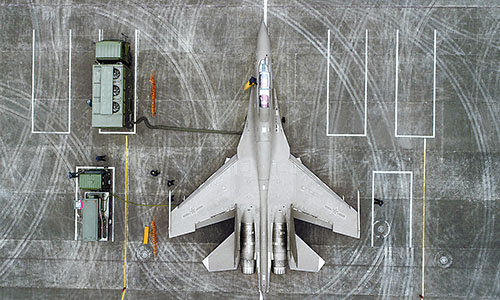
A J-16 fighter jet attached to an aviation brigade of the air force under the PLA Western Theater Command sits on the parking apron while receiving power-on inspections prior to a flight training exercise in southwestern China's Chongqing Municipality on March 6, 2018. (eng.chinamil.com.cn/Photo by Liu Chang and Liu Yinghua)


The Chinese People’s Liberation Army (PLA) Western Theater Command is reportedly commissioning more J-16 aircraft, a type of powerful fighter jet capable of controlling air, sea and land, in a move to better safeguard China’s territorial integrity in the country’s western regions, analysts said on Monday.

A brigade attached to the PLA Western Theater Command Air Force recently conducted a confrontational air-to-air combat exercise in order to examine and enhance the unit’s comprehensive combat capability, Shanghai-based news website eastday.com reported on Sunday, citing a recent article released by the official WeChat account of the PLA Western Theater Command Air Force.

According to photos and descriptions by the Western Theater Command Air Force, this brigade is in a key period of switching to use the J-16 heavy fighter jets, and the goal is to finish the process by the end of the year, the report said.

This means this brigade is the latest unit in the Western Theater Command Air Force to use the J-16, following another Western Theater Command Air Force brigade based in Southwest China's Chongqing Municipality that made the switch earlier, eastday.com reported.

With more Western Theater Command Air Force units switching to use J-16s, China’s western airspace will be even safer, the report said.

The J-16 is a third-plus generation fighter jet domestically manufactured by China. Although it uses the classic Russian Su-27 aerodynamic design, everything inside is Chinese, including the WS-10 Taihang engines, an active array radar system and a new generation infrared observation and aiming system, the report said, noting that its avionics systems are superior to Russia’s Su-35 fighter jet.

The J-16 excels at carrying out all kinds of tasks, including long-range and short-range air-to-air combat, and air-to-ground and anti-ship attack missions, a Chinese military expert who asked not to be identified told the Global Times on Monday.

Its advanced avionics systems and the capability to carry a large amount of all sorts of munitions mean it is one of the PLA Air Force’s most powerful fighter jets, possibly only inferior to the J-20 stealth fighter jet, the expert said, noting that the J-16 has technical advantages over the threats China is facing in the west.

The J-16 can also partner the J-20 in missions, the eastday.com report said.

The eastday.com report also noted that the J-16 fighter jets newly used by the Western Theater Command Air Force brigade are painted with the latest version of low observable coatings, which experts said are developed to lower the chance of the warplanes being detected by the naked eye or radar.


J-16 fighter: Details

MiG-29K trainer aircraft of Indian navy crashes into Arabian sea, pilot missing

Official U.S. Navy Imagery


MiG-29K trainer aircraft of Indian navy crashes into Arabian sea, pilot missing - People's Daily Online

(Xinhua)    14:38, November 27, 2020

NEW DELHI, Nov. 27 (Xinhua) -- A MiG-29K trainer fighter aircraft belonging to Indian navy crashed into the Arabian sea, following which a pilot went missing, officials said Friday.

Another pilot onboard was rescued.

The fighter jet crashed during a training mission on Thursday evening.

"A MiG-29K trainer aircraft operating at sea met with an accident at about 5:00 p.m. (local time) on Thursday. One pilot has been recovered and search by air and surface units in progress for the second pilot," reads a statement issued by Indian navy.

Meanwhile, navy has ordered an inquiry to investigate the incident.


MiG-29K: Details 

Thursday, 26 November 2020

Russian Baltic Fleet receives latest fast-speed landing craft for special forces

rybinskshipyard.ru


Russian Baltic Fleet receives latest fast-speed landing craft for special forces - Military & Defense - TASS

The assault boat can be used to provide fire support for the landing party, participate in anti-saboteur measures, fight piracy and terrorism, carry light cargoes and take part in rescue operations

BK-16, a high speed landing boat
© Anton Novoderezhkin/TASS


KALININGRAD, November 24. /TASS/. A Project 02510 BK-16 high-speed amphibious assault boat has entered service with Russia’s Baltic Fleet, Fleet Spokesman Roman Martov told TASS on Tuesday.

"The Project 02510 high-speed troop carrier and landing craft of the BK-16 type built at the Rybinsk Shipyard has entered service with the Baltic Fleet and will operate at a Fleet special forces unit stationed in the Kaliningrad Region," the spokesman said.

This is the first Project 02510 boat that has joined the Baltic Fleet’s combat structure. In 2021, the Baltic Fleet is set to receive several more boats of this type, he said.

The Project 02510 Type BK-16 high-speed amphibious assault boat is designated for commandos’ amphibious operations and can be used to sealift and land an amphibious assault force, provide fire support for the landing party, participate in anti-saboteur measures, fight piracy and terrorism, carry light cargoes and take part in rescue operations. The boat can accommodate three crewmembers and up to 18 personnel.

The Project 02510 BK-16 amphibious assault boat is 16 meters long and 4 meters wide. It displaces 22 tonnes, develops a speed of 40 knots (almost 75 km/h) and has an operating range of up to 400 nautical miles.

The boat is outfitted with a remote-controlled weapon station developed by the Kalashnikov Group and capable of detecting and striking targets in the daytime and at night in any weather conditions. The combat module features armor protection against B-32 armor-piercing 7.62mm bullets and a gyro-stabilized platform.


Russian Defense Ministry receives last three Su-35S fighters under 5-year contract

Ilya Solovey


Russian Defense Ministry receives last three Su-35S fighters under 5-year contract - Military & Defense - TASS

The Su-35S is designated to strike air, ground and naval targets and infrastructural facilities shielded by air defense systems and located at a considerable distance from home airfields

MOSCOW, November 25. /TASS/. The Russian Defense Ministry said it had received the last three Su-35S fighter jets (NATO reporting name: Flanker-E+) as part of the five-year contract for 50 such aircraft.

"Specialists of the 485th military office of the Russian Defense Ministry accepted three Su-35S multirole fighter jets of the 4++ generation. The planes have been redeployed from the plant in Komsomolsk-on-Amur [in Russia’s Far East] to permanent bases of the Russian Aerospace Forces," the ministry said.

The ministry said the delivery completes the five-year contract, under which the Russian Aerospace Forces were to receive 50 Su-35S fighter jets in total.

Two fighter jets will be on duty at the Defense Ministry’s training and trials center in the Central Russian city of Lipetsk. The third one will continue its service at an air force regiment in Komsomolsk-on-Amur.

The Su-35S is a heavily upgraded generation 4++ super-maneuverable multipurpose fighter jet developed on the basis of fifth-generation technologies. The Su-35S is distinguished by its new avionics suite based on an information control system, a new radar and plasma ignition engines of the increased capacity and thrust vectoring. These engines meet the requirements for the powerplant of fifth-generation fighters as they allow developing supersonic speed without using an afterburner.

The Su-35S is designated to strike air, ground and naval targets and infrastructural facilities shielded by air defense systems and located at a considerable distance from home airfields.

The Su-35S supersonic fighter jet performed its debut flight on February 19, 2008. The fighter jet is a derivative of the Su-27 plane. The Su-35S weighs 19 tonnes, has a service ceiling of 20,000 meters, can develop a maximum speed of 2,500 km/h and has a crew of one pilot. The fighter jet’s armament includes a 30mm aircraft gun, up to 8 tonnes of the weapon payload (missiles and bombs of various types) on 12 underwing hardpoints. The Su-35S has been in service with the Russian Army since 2015.