Russia completes delivery of T-90S/SK tanks to Vietnam | Jane's 360: Moscow has completed the delivery of 64 T-90S/SK main battle tanks (MBTs) to Vietnam, the Russian Federal Service for Military-Technical Cooperation (FSVTS) confirmed to Jane's on 28 March. A military-diplomatic source said "the multi-faceted contract" that was signed in 2016 for the MBT acquisition "has been fulfilled in accordance with the original schedule". "All the financial issues under the contract have been resolved, and the Vietnamese tank crews and technical specialists have already been trained," the source added. A representative of the Vietnam People's Army (VPA) told Jane's that the MBTs were shipped in two large batches, each totalling "no fewer than 30 platforms". "The first batch was delivered last December, while the second one arrived in Vietnam in late February," said the source, adding that the VPA received the MBTs equipped with Kontakt-5 explosive reactive armour and a turret-mounted missile countermeasures system. "The vehicles will replace outdated Chinese Type 59 and non-upgraded Soviet-era T-54 tanks," he said, pointing out that the VPA has already begun operating the new vehicles. In July 2017 Vietnamese state-run news agencies confirmed that Hanoi had ordered 64 T-90Ss, including an undisclosed number of T-90SK variants, pointing out that the acquisition would be funded by credit provided by Moscow. The T-90S is the basic export model, while the 'K' is a reference to command versions.
LIMA 2019: Russia set to clear Sukhoi Su-57 for export | Jane's 360: The Russian government is set to grant authorisation for the export of the Sukhoi Su-57 PAK FA fifth-generation fighter aircraft, a senior Russian defence industry official has revealed. Viktor Kladov, the director for international co-operation and regional policy at Russia's Rostec defence industrial holding company, said the version of the aircraft promoted to international customers will be named Su-57E (Export). He added that he expects the aircraft to be a competitive bidder for programmes in the Middle East and some parts of Asia Pacific. Speaking at a media briefing at the 2019 LIMA exhibition in Langkawi, Kladov said that "all the necessary documentation" to support the approval of exports of the Su-57E has been submitted to the Russian government by UAC and its parent company, Rostec. Final export approval is expected to be provided by Russian President Vladimir Putin in a few weeks. According to Kladov the Su-57E could be officially unveiled at the Dubai Air Show in November 2019, and this unveiling would reflect the target export market of the Su-57E. "We believe that the Middle East is an attractive market for this aircraft," said Kladov. In Asia Pacific, countries likely to be interested in the Su-57E include China and India. "China has recently taken delivery of 24 Su-35 aircraft," said Kladov, "and in the next two years [China] will make a decision to either procure additional Su-35s, build the Su-35 within China, or to buy a fifth-generation fighter aircraft. This could be another opportunity for the Su-57E." In marketing the aircraft for export, Kladov said customers are unlikely to be dissuaded by the US Countering America's Adversaries Through Sanctions Act (CAATSA). This legislation, introduced in August 2017, proposed sanctions on Russia's defence customers in response to Moscow's alleged interference in the 2016 US presidential election and the annexation of Crimea.
Raytheon Presses Hard For More Army Biz: NGCV, DeepStrike, Coyote « Breaking Defense - Defense industry news, analysis and commentary: The growing threat from potential near-peer adversaries, such as Russia and China, has propelled the Army into an all-out drive to rapidly modernize with an array of weapons ranging from technologically enhanced ground combat vehicles to long-range precision-guided missiles. The Army showed its commitment to that quest in its recently released fiscal 2020 budget that allocated billions of dollars, cut from older programs, to fund its modernization priorities. That should be good news for Raytheon Missile Systems (RMS), which has moved to closely align its programs to meet the Army’s requirements, including two of its top six priorities. RMS is prepared to enter the Army’s Optionally Manned Fighting Vehicle (OMFV) program with a replacement for the Bradley Fighting Vehicle and is testing an answer to the high-priority search for an extended-range, precision-fire system. It also is offering upgraded versions of its proven anti-tank weapons, its FLIR low-light sighting system and is ready to move into production of a counter UAS (CUAS) weapon, a senior Raytheon official said.............click above link for entire article
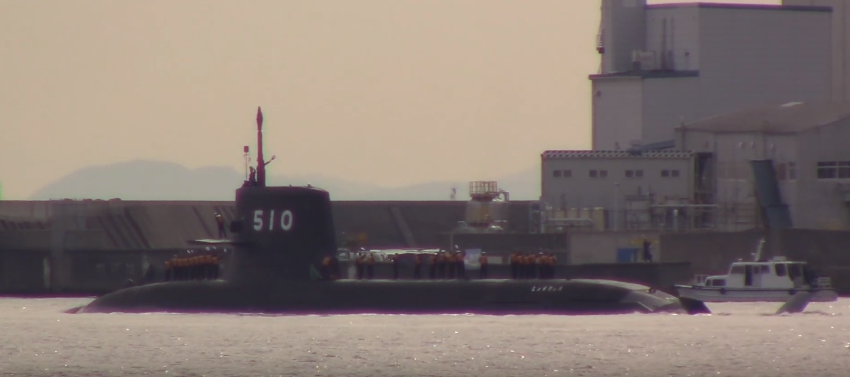
The JMSDF has commissioned its 10th Soryu-class SSK
The Soryu-class boats are Japan’s first submarines to feature AIP, which enables them to stay submerged for extended periods
The Japan Maritime Self-Defense Force (JMSDF) commissioned its 10th Soryu-class diesel-electric attack submarine (SSK) on 18 March in a ceremony held in Hyogo Prefecture in west-central Japan. Named JS Shoryu (with pennant number SS 510), the 84-m-long boat was inducted into the JMSDF's Submarine Flotilla 1, based in Kure, Hiroshima Prefecture, shortly after being handed over by shipbuilder Kawasaki Heavy Industries (KHI) at its facility in Kobe, the company said in a press statement. Shoryu , which was launched in November 2017, is the fifth submarine of the class to be built by KHI, with the other five having been built by Mitsubishi Heavy Industries (MHI). The total cost of acquiring the submarine is about JPY56 billion (USD502 million), a spokesperson at the JMSDF told Jane’s on 18 March. According to Jane’s Fighting Ships , the Soryu class has a beam of 9.1 m, a hull draught of 8.4 m, and a displacement of 2,947 tonnes when surfaced and 4,100 tonnes when submerged. Powered by two Kawasaki 12V 25/25 diesel engines and four Kawasaki Kockums V4-275R Stirling air-independent propulsion (AIP) engines, the class has a top speed of 20 kt when submerged and 12 kt when surfaced. The Soryu class is equipped with six 533 mm bow torpedo tubes that can fire the Japanese-developed Type 89 heavyweight torpedo. The boats are also capable of deploying the UGM-84C Harpoon medium-range anti-ship missile against surface targets. Each submarine since the eighth of the class has also been equipped with an undisclosed number of countermeasures, according to a spokesman from the Japanese Ministry of Defence. The 11th of the class and the sixth to be built by MHI, Oryu (with pennant number SS 511), was launched in October 2018 and is the first Soryu-class SSK for the JMSDF to be equipped with lithium-ion batteries in place of lead-acid batteries. 潜水艦 しょうりゅう SS-510 引渡式 出港 BakanekoFilm Published on Mar 18, 2019
Get Ready, NATO: Russian Air Force Tu-22M3 Backfire Bombers are in Crimea | The National Interest: Why? The Russian air force has deployed "squadrons" of Tu-22M3 Backfire bombers to the Crimean Peninsula, which Russia illegally seized from Ukraine in early 2014. The deployment puts the bombers within close striking range of NATO countries and any U.S. Navy carrier battle groups sailing the Mediterranean Sea. The bombers are a response to NATO's establishment of a ground-based missile-defense system in Romania in 2015, Russian senator Viktor Bondarev told journalists on March 18, 2019. Bondarev's claim points to a pernicious and popular Russian conspiracy theory that for years has been undermining Moscow's relations with the West. "The deployment of American missile defense systems in Romania came as a major challenge, in response to which the Russian defense ministry made the decision to deploy long-range missile-carrying bombers," Bondarev said. "This move has drastically changed the balance of forces in the region." Bondarev said the bomber deployment, plus the basing of Iskander ballistic missiles in Crimea, prevent Ukraine, the United States and NATO from ever bottling up the Russian Black Sea fleet. The Russian air force is upgrading 30 of its 67 Tu-22M3s to the new M3M standard with new engines and weapons. "The recently improved Russian version of the Backfire, the Tu-22M3M, represents enhanced capability in virtually every area except stealth," Mark Schneider, an analyst with the National Institute for Public Policy, wrote in Proceedings, the professional journal of the U.S. Naval Institute. The Backfires will receive the upgrades and enter service starting in 2021, Schneider reported, citing Russian state media. Backfires flying from Crimea could lob missiles across the Mediterranean Sea. "It were not for a prompt return of Crimea and [the port of] Sevastopol [on Crimea] within Russia, these territories would have gone under protectorate of the U.S.," Bondarev said. "The American ‘parent country’ would have immediately deployed its weapons systems there. In case of a war, obstacles could have been put without hindrance for our ships, for example through mining the floor of the Bosporus." Russia's stationing of heavier and longer-range weaponry in Crimea comes amid escalating regional tensions. In late November 2018, Russian security forces illegally seized three Ukrainian navy boats attempting to pass through the narrow, Russian-controlled strait connecting the Black Sea and the smaller Sea of Azov. Moscow continues to detain the Ukrainian boats' crews. The European Union in response has threatened to impose sanctions. Russia's official rationale for deploying forces to Crimea in part hints at a popular conspiracy theory. The Aegis Ashore missile-defense site in Romania specifically is designed to intercept ballistic missiles coming from Iran. It doesn't pose a serious threat to Russian forces. But Aegis Ashores "play[s] to a very specific Russian fear," said Jeffrey Lewis, a nuclear expert at the Middlebury Institute of International Studies at Monterey. Lewis said many Russians believe the United States has planned for years to secretly arm its missile-defense installations in Poland and Romania with nuclear weapons, transforming defensive weapons into what Lewis describes as a "covert" strike force whose true mission is to launch a surprise atomic attack on Moscow in order to "decapitate" the Russian government. "It's insane but I swear they 100-percent believe this," Lewis said of the Russians. The same conspiracy theory undermined the Intermediate-Range Nuclear Forces Treaty, an accord that for 32 years helped to limit the spread of medium-range atomic missiles. In the early 2000s, shortly after the United States launched development of Aegis Ashore, Russia began testing a ground-launched nuclear-capable cruise missile that violated the terms of the 1987 INF Treaty. The cruise missile was Russia's first response to the notion that the West was planning to use Aegis Ashore to launch a sneak attack on Moscow. In February 2019, citing Russian prevarications, the U.S. State Department formally notified Moscow of its intention to withdraw from the INF Treaty. The United States is developing medium-range nuclear missiles of its own, potentially fueling a new atomic arms race. Now the same conspiracy that ultimately led to the demise of a key nuclear-arms treaty is driving Russia's deployment of long-range forces to Crimea. David Axe serves as Defense Editor of the National Interest. He is the author of the graphic novels War Fix, War Is Boring and Machete Squad.
Malaysia and Azerbaijan Headline Pakistan’s Fresh JF-17 Sales Efforts: The Pakistan Air Force (PAF) and Pakistan Aeronautical Complex (PAC) are renewing their efforts to secure additional customers for the JF-17 Thunder lightweight multi-role fighter, which is co-produced by the Aviation Industry Corporation of China (AVIC) and PAC, and is the mainstay combat aircraft of the PAF. These efforts follow deliveries of the JF-17 to Myanmar, which had reportedly ordered 16 aircraft in 2015, and Pakistan’s Economic Coordination Committee (ECC) greenlighting a $184 million sale of three aircraft to Nigeria in late 2018 (Nigeria earmarked a $35 million installment for the order in its 2018 budget). Currently, Malaysia and Azerbaijan appear to be the PAF and PAC’s top priorities for securing sales – both countries are high-value prospects. With at least 100 JF-17s inducted into the PAF fleet and, following the February 2019 air skirmish with India, the PAF seemingly accrediting the MiG-21bis kill to the Thunder (via Air Forces Monthly), a big-ticket sale to a third-party would drive significant momentum. Malaysia On March 22, the Pakistani Minister of Finance, Asad Umar, reportedly told local media that Malaysia had shown interest in purchasing the JF-17 alongside anti-tank missiles from Pakistan. Invited as a guest of honour at the Pakistan Day Parade, the Malaysian Prime Minister Mahathir Mohamed was given a briefing of the JF-17. However, reports of PAC’s speaking with Malaysia about the JF-17 stem as early as 2015, when reports initially emerged of Islamabad proposing the fighter to Kuala Lumpur. The Malaysian Minister of Defence at the time, Datuk Seri Hishammuddin Tun Hussein, had denied of any such dealings. In 2016 and 2017, it had seemed that the Royal Malaysian Air Force (RMAF) would procure a Western European fighter, especially as Saab and BAE had reportedly been willing to extend loans/lines-of-credit to back the Gripen and Typhoon, respectively. Malaysia has largely favoured Western systems. However, at the 2018 Defence Services Asia (DSA) exhibition in Kuala Lumpur, PAC told IHS Jane’s that it and the Malaysian side were in “primary level talks” regarding the JF-17. This round comes following the RMAF opting to procure lightweight fighters to augment its fleet and, potentially, supplant its MiG-29s. PAC had still cautioned that these were not ‘serious’ talks, but the Malaysian Prime Minister’s recent visit to Pakistan may have potentially pushed the matter to a more substantive level. Is Pakistan Prioritizing Munitions Development? (Part 1) According to UkrOboronProm, which is Ukraine’s state-owned parent company overseeing the country’s various defence vendors – such as Antonov – Pakistan and Ukraine agreed to collaborate on developing munitions … | Read More The Foreign Relations Side Involves China Rarely do marquee defence purchases, such as those of combat aircraft, separate the technical merits of the acquisition from its foreign relations realities. Malaysia’s current fiscal constraints notwithstanding, it is unrealistic to expect Pakistan to win-out against better backed competitors. However, when it comes to a JF-17 proposal, Pakistan is not the only factor – there is China as well. Thus, a potential sale in a market as significant as Malaysia will likely see PAC leverage AVIC’s support (including offset, financial, and transfer-of-technology carrots). On the other hand, China itself has only entered the Malaysian defence and security market recently, with its recent watershed sale being four Littoral Mission Ships (LMS) to the Royal Malaysian Navy. Though the LMS has a scope for up to 18 ships, there is no guarantee that the Chinese LMS program will mature to that extent. Thus, a JF-17 sale in Malaysia will likely be an uphill battle for AVIC and PAC, but the Thunder is not without its own competitive strengths in terms of cost and readily available versatility. End of Excerpt. Mahathir Mohamad receives briefing on JF-17 before leaving Islamabad | Pakistan | thenews.com.pk Malaysia interested in procuring JF-17 Thunder, anti-tank missiles from Pakistan | Business - Geo.tv
THE MYTH OF THE EXPORT FIGHTER:For over a decade, the OA-X light attack aircraft has been touted as ripe for export. Indeed, the OA-X enabling concept, which started the ball rolling for a light attack aircraft, specifically called for the aircraft to be transferrable, affordable, modular, and interoperable — all characteristics that would make it exportable. The view was always that the U.S. Air Force needed an aircraft that it could use for low-intensity conflict, and also share with partners. A key element in the concept was sharing — not selling. By 2011 Gen. Norton A. Schwartz, then Air Force chief of staff, had altered the concept, retitled “Light Attack / Armed Reconnaissance,” into a program that would train foreign airmen for an aircraft that the U.S. Air Force would not itself operate...........click above link to read entire article F-20 Tigershark:Details F-5E Tiger II & F-5T-Tigris:Details