Wednesday, 7 September 2016

US links future of joint jet engine development project to manufacture fighter plan


By Manu Pubby, ET Bureau | Sep 07, 2016, 07.00 AM IST

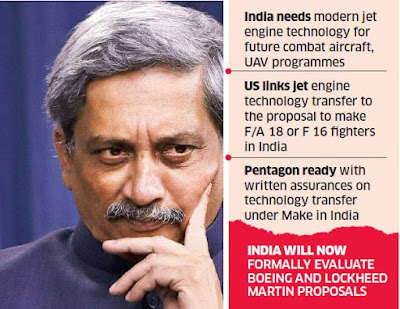
NEW DELHI: The US has linked the future of a joint jet engine development project to a proposal to manufacture American combat aircraft under the Make in India initiative, with Pentagon formally putting all options on the table, including sharing of high-end weapons, radar and power plant technology, during Defence Minister Manohar Parrikar's recent visit.

Sources told ET that India will now be able to formally evaluate two proposals from US companies Boeing (F/A 18 Super Hornet) and Lockheed Martin (F16 Super Viper) to make jets in India with Pentagon giving a written assurance for transfer of technology.

A renewed push for the jet aircraft project came during the Parrikar visit, with an assurance that high-end jet engine technology that India seeks for its future combat aircraft programmes is also on the table.

In fact, officials told ET that US Secretary for Defence Ashton Carter may be visiting India as early as December to take the process forward. Sources who took part in the discussions said that while in April, when the two US companies had first offered the two jets for a Make in India plan, there was reluctance in Washington on how much technology could be shared.

However recent initiatives, including India's entry into the Missile Technology Control Regime (MTCR) and the signing of a military logistics support agreement, have changed things on the ground.

It is learnt that the offer from Boeing, which makes the F/A 18, is for the setting up of a new worldclass production facility in India that would cater to the production of futuristic combat aircraft.


Lockheed Martin proposes to shift its F 16 fighter line from Texas to India as the sole production facility in the world.

As reported first by ET, in April rivals Boeing and Lockheed Martin jointly met top defence ministry officials in New Delhi offering to locally manufacture the fighter jets.

The offer came after Defence Minister Manohar Parrikar publicly stated that the ministry is interested in setting up production lines for 'one or two' fighters at the earliest, beyond the Rafale fighter jet deal with France.

Original post: economictimes


India must be really desperate to chose the US jets which are very old platform, the Gripen E/F is a better deal.

I guess everything has to do with politics.

India already have bad experienced with the C-17!


Related latest post:

Tuesday, 6 September 2016

Over 100 Saudi Tanks, Armored Vehicles, Drones, 2 Apache Helicopters Destroyed in Yemen Missile Attack


Mon Sep 05, 2016 1:26
At least 100 tanks and armored vehicles of the Saudi army were destroyed after Yemen's ballistic missiles hit Ein al-Thourin military base in Najran province in the Southern part of the kingdom.
The Yemeni missile attack also destroyed 25 rocket-launching vehicles, several drones, two Apache military helicopters and 3 fuel tankers.
The Yemeni army, backed by popular forces, took control of several military bases in Saudi Arabia's Asir province.
The military bases which are located in the Western part of al-Rabou'a city were taken after intense clashes between the Yemeni and Saudi forces.
The images released after the operation showed the Saudi military men leaving their armored vehicles and fleeing the battlefield.
Also, the artillery units of the Yemeni army targeted the gathering centers of Saudi-affiliated militia at Koufel military base in Ma'rib which killed and wounded tens of them.
On Friday, Yemen's long-range home-made missile dubbed as Borkan-1 (Volcano-1) hit deep inside Saudi Arabia in response to the kingdom's massacre of civilians in the impoverished nation.
Borkan-1 has a range of 800 kilometers and is a new generation of Yemen's domestically-made missiles, Yemen's Defense Ministry announced in a statement on Friday.
The Yemeni defense ministry did not mention the exact location of the targets that Borkan-1 missile has hit.
It, however, said that the warhead of Borkan-1 missile has been designed to destroy the Saudi military base structure with respect to the materials used in their construction.
On Wednesday, the Yemeni army and popular forces hit the Saudi military positions in the kingdom's Najran province with a Zalzal-3 ballistic missile in retaliation for the Saudi airstrikes on residential areas across Yemen.
The Yemeni missile attack inflicted heavy losses on the Saudi troops in Najran province.
Original post: farsnews

Map of Saudi Arabia with 'Asir highlighted

Yemeni reporter inside Saudi Arabia posing on a Abrams tank in Jizan DD.SEPTEMBER 15, 2015


Related post:


Borkan-1 missile
The solid propellant and Scud-type Borkan-1 missile reportedly has a range of more than 800 kilometers (497 miles).

Monday, 5 September 2016

Armored car tiger-M Spetsnaz be first shown at the 2016 Army forum (Броневик Тигр-М СпН впервые будет показан на форуме Армия-2016) - Video


Published on Sep 4, 2016
На форуме Армия-2016 впервые будет показан автомобиль, которому нет аналогов в мире! Это колесный броневик Тигр-М СпН с автоматизированным модулем. В такой комплектации наш российский броневик становится роботизированным комплексом.

Translated by google

The forum Army 2016 will debut the car, which has no analogues in the world! It wheeled armored Tiger-M Spetsnaz with automated module. In such a configuration becomes our Russian armored robotic complex.

Related post:

Russia Tests Advanced New 21st Century Anti-Tank Weapon System – With full details

Beijing Yanjing Motor Company to produce Russian GAZ Tigr Multirole Utility Vehicles under license

Sunday, 4 September 2016

China forces Barack Obama to emerge from Air Force One's 'ass' in sharp diplomatic snub


Unlike the warm reception given to other world leaders like Theresa May and Vladimir Putin, Barack Obama was denied a red-carpet welcome.

US President Barack Obama disembarks through Air Force One's little-used door at Hangzhou Xiaoshan international airport before the G20 Summit in Hangzhou, Zhejiang province, ChinaDamir Sagolj/Reuters

US President Barack Obama, often heralded as the world's most powerful leader, was forced to go out of Air Force One's "ass" when his plane landed in China in what has been regarded as a sharp and calculated diplomatic snub by Beijing.
With no staircase provided for him to emerge from the usual door – which is at the front of Air Force One – Obama had to disembark from the exit of the plane's belly marking a pointed departure from protocol . This alternative exit was little used in the past and that too only for security purposes. As he was going out of Air Force One's door, he was barely visible to reporters and photographers, who were kept under the wing of the aircraft by a blue tape.
Conspicuously, there was also no red-carpet welcome for the US president at the tarmac unlike in the case of most other leaders including Russia President Vladimir Putin, Prime Minister Theresa May, South Korean President Park Geun-hye and Indian Prime Minister Narendra Modi. All the leaders are in the eastern Chinese city of Hangzhou for the G20 summit.
Obama's unusual exit and the less-than-graceful welcome were shortly followed by a verbal encounter between the American press corps and Chinese security officials. The US National Security Adviser, Susan Rice, who the New York Times said, was "baffled and annoyed" by the arrangements, later told reporters about the alleged diplomatic snub by the Chinese: "They did things that weren't anticipated."
During the altercation, a Chinese security official was caught on the video telling a US presidential aide: "This is our country! This is our airport!" Chinese officials have not yet commented on the episode.
"It sure looks like a straight up snub. This clearly plays very much into the [idea]: 'Look, we can make the American president go out of the ass of the plane,'" Bill Bishop, a Chinese expert who closely tracks political developments in Beijing, told the Guardian. "The idea that they have been preparing for well over a year for the G20 but suddenly there be a malfunction with the ramp just for one president ... that really strains credulity." Multiple others have also said that the treatment given to the US president was not a cock-up.
When asked about potential conflicts and the cold reception, Obama told a press conference, "the seams are showing a little more than usual", but quickly played it down by adding: "I wouldn't over-crank the significance of it."
Original post: ibtimes
Air Force One: Details

Saturday, 3 September 2016

PKL Services gets $495 million Saudi F-15 support contract


U.S. Air Force deal covers Royal Saudi Air Force's F-15 S- and SA-type aircraft.
By Geoff Ziezulewicz   |   Sept. 2, 2016 at 11:00 AM
WASHINGTON, Sept. 2 (UPI) -- PKL Services has been awarded a $495 million U.S. Air Force contract for work on the Royal Saudi Air Force's F-15 fleet.
The indefinite-delivery/indefinite-quantity contract covers maintenance, upgrade and training of the Saudi Strike Eagle S- and SA-type fighters.
Work will be performed and has an estimated completion date of August 2021. The contract is 100 percent foreign military sales to Saudi Arabia.
The 338th Specialized Contracting Squadron is the contracting activity.
The Royal Saudi Air Force has flown the F-15S fighters since the 1990s, Boeing said.
The F-15SA was rolled out in 2013 and featured improved performance and increased survivability at a lower life-cycle cost.
It also features two additional wing stations for increased payload and capability.
Original post: upi

Related post:

Thursday, 1 September 2016

Tata Power, Javelin JV to develop, produce anti-armour missile system


ATEEQ SHAIKH | Thu, 1 Sep 2016-07:35am , Mumbai , dna

Tata Power has signed a letter of intent (LOI) with US-based Javelin Joint Venture for its Strategic Engineering Division (SED) to explore development and production of anti-armour missile system.
The Javelin Joint Venture is a partnership between Raytheon Company and Lockheed Martin. The LOI establishes a framework for future technological cooperation among the three leading companies of the globe.
As part of the LOI, Javelin Joint Venture (JJV) and Tata Power's Strategic Engineering Division will create a strategy to co-develop and produce the Javelin missile system and integrate platform mounts to meet India's defence requirements. As per the plan, even ground combat vehicle, dismounted infantry and rotorcraft applications will be manufactured jointly.
This move comes at a time when the government is working towards having private participation in the defence sector and Make in India initiative.
"This agreement brings together three world leaders in aerospace and defence technology to extend Javelin to new customers, new applications and new platforms. With this deal, we are also reinforcing our continued support of the 'Make in India' initiative," said John Halvey, Javelin Joint Venture president at Raytheon Missile Systems.
Rahul Chaudhry, chief executive officer at Tata Power SED shared, "Now, our partnership with the Javelin Joint Venture will bring the world's best technology to our soldiers enabling battlefield supremacy. Indian industry will benefit immensely from the depth and range of this planned technology transfer and co-development."
On Wednesday, Tata Power's stock touched a 71-week high at Rs 78.65; the previous high was on April 23, 2015, when it's share price was at Rs 79. The stocks opened at Rs 77.05, fell to a low of Rs 76.55, but later touch 16-month high to end at Rs 78.25 per share.
Original post: dnaindia
Javelin Portable Anti-Tank Missile
The Javelin system consists of the CLU and the round. With a carry weight of 6.4kg, the CLU incorporates a passive target acquisition and fire control unit with integrated day sight and thermal imaging capabilities.
The sight uses DRS Technologies' second-generation thermal imaging technology, based on the standard advanced Dewar assembly (SADA IIIA). The company also provides the quieter, dual-opposed piston coolers for the sight.
The gunner's controls for the missile system are on the CLU. The day sight is equipped with x 4 magnification and the night sight with x 4 and x 9 magnification optics.
Image: globalsecurity.org
The round consists of the Javelin missile and the ATK (Alliant Techsystems) launch tube assembly. The range of the missile is 2,500m. Javelin is a fire-and-forget missile with lock-on before launch and automatic self-guidance.
The missile is equipped with an imaging infrared seeker, which is based on a cadmium mercury telluride (CdHgTe) 64 x 64 staring focal plane array in the 8 micron to 12 micron waveband. BAE Systems Avionics is providing the infrared seekers for the British army's missiles.
The tandem warhead is fitted with two shaped charges: a precursor warhead to initiate explosive reactive armour and a main warhead to penetrate base armour. The propulsion system is a two-stage solid propellant design, which provides a minimum smoke soft launch.
The Block 1 missile upgrade includes an improved rocket motor that reduces time of flight, an enhanced warhead effective against a greater range of targets, 2,500m of improved probability of hit / kills and improvements to the command launch unit and software. In 2008, the improved Block 1 missile full material release was received and the US army has stockpiled the first production lots.
Other improvements include a digital display, software processing enhancement and remote view of the gunner display in an RS-170 standard video format. The future Javelin will have fragmentation for anti-personnel effects and a multipurpose warhead (MPWH) with shaped charges for armoured vehicles.
Javelin missile system operation
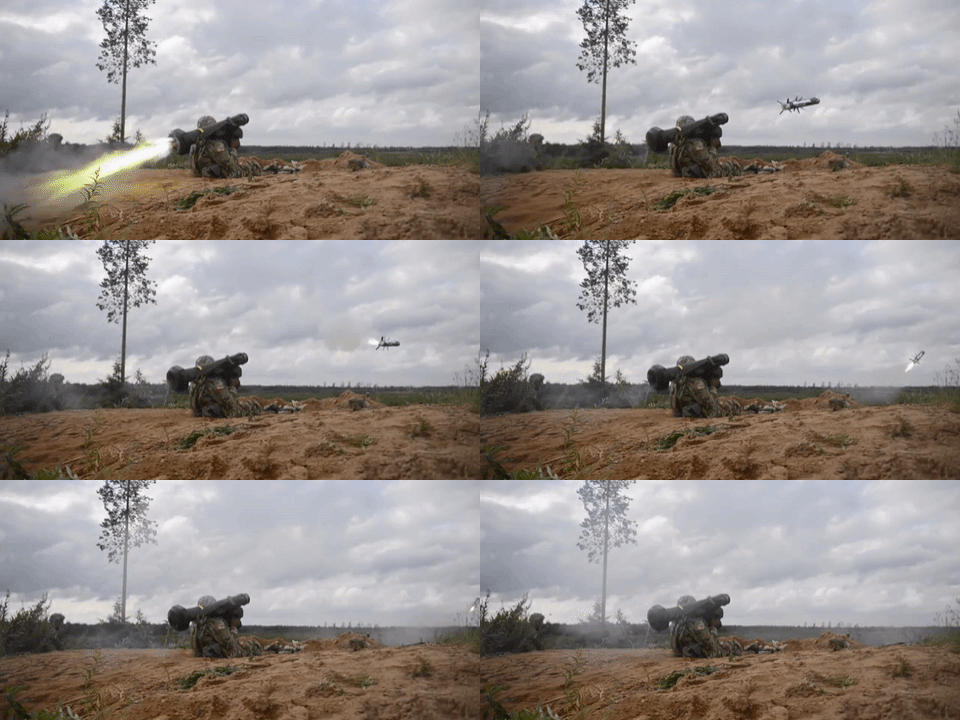
The system is deployed and ready to fire in less than 30s and the reload time is less than 20s. The missile is mounted on the CLU and the gunner engages the target using the sight on the CLU, by placing a curser box over the image of the target. The gunner locks on the automatic target tracker in the missile by sending a lock-on-before-launch command to the missile. When the system is locked-on, the missile is ready to fire and the gunner does not carry out post launch tracking or missile guidance.
Unlike laser beam riding or conventional wire or fibre-optic cable guided missiles, Javelin is autonomously guided to the target after launch, leaving the gunner free to reposition or reload immediately after launch.
A soft launch ejects the missile from the launch tube to give a low-recoil shoulder launch. The soft launch enables firing from inside buildings or covered positions. Once the missile is clear, the larger propellant in the second stage is ignited and the missile is propelled towards the target. The weapon has two attack modes, direct or top attack.
The gunner selects direct attack mode to engage covered targets, bunkers, buildings and helicopters.
The top attack mode is selected against tanks, in which case the Javelin climbs above and strikes down on the target to penetrate the roof of the tank where there is the least armour protection.
The missile is launched at an 18° elevation angle to reach a peak altitude of 150m in top attack mode and 50m in direct fire mode.
Image: globalsecurity.org
Variants
FGM-148A, initial version of the Javelin;
FGM-148B, improved version of the Javelin;
FGM-148C, improved version of the Javelin;
FGM-148D, export version of the Javelin;
FGM-148F, missile fitted with multi-purpose warhead. It is much more effective against enemy personnel, weapon crews, buildings and lightly armored or unarmored vehicles. This missile is still lethal against tanks.

FGM-148
Entered service
1996
Armor penetration
800 mm
Range
2 500 m
Weight
22.3 kg
Missile length
1.1 m
Launch tube length
1.2 m
Missile diameter
1.27 m
Launch tube diameter
1.42 m
Carry weight
22.3 kg
CLU weight
~ 6.4 kg
Warhead
Tandem HEAT
Warhead weight
8.4 kg
Guidance system
Imaging infrared

Uruguayan Air Force eyeing China's Hongdu L-15


Santiago Rivas, Buenos Aires - IHS Jane's Defence Weekly
30 August 2016
The Uruguayan Air Force, worried about the current state of its combat fleet, sent a group of officers to China to analyzs the Hongdu L-15 advanced trainer for a possible purchase, air force sources told IHS Jane's .
The aircraft was offered by the Chinese government as a replacement for Uruguay's A-37 Dragonfly (Cessna 318E) aircraft, which are currently grounded after one was lost during a crash on 12 August. The Uruguayan officers' trip to China was planned before the crash, but the incident led to increased government interest in replacing the A-37Bs.
Uruguay is interested in buying 8-12 aircraft, with support and training, to serve in the Escuadrón No 2 of the Brigada Aérea No 2 at Durazno Air Base.

Original post: janes

Hongdu JL-10/L-15: Details