Sunday, 11 September 2016

Argentina evaluates Korean FA-50 fighter


Gareth Jennings, London - IHS Jane's Defence Weekly
09 September 2016

The Argentine Air Force (Fuerza Aérea Argentina - FAA) is evaluating the Korean Aerospace Industries (KAI) FA-50 Fighting Eagle as a potential new platform, IHS Jane's has learned.

An Argentine delegation visited the Republic of Korea Air Force's (RoKAF's) 16th Fighter Wing at Yecheon on 7 September, according to the Facebook page of one of the FAA pilots who was also photographed taking-off in a TA-50 Golden Eagle operational trainer variant of the FA-50.

No further details were revealed.

The FAA has a pressing need to acquire a new fighter type following the retirement of the Dassault Mirage III and Mirage 5 fleets in late 2015, and the subsequent grounding of the Douglas A-4R Fightinghawk fleet.

Although billed as a 'light' fighter, the FA-50 has a potent air-to-air and air-to-surface capability. According to IHS Jane's All the World's Aircraft: In Service , the type carries AIM-9L/M/N/P/S Sidewinder missiles and is equipped with an internal cannon for the former role, and for the latter it is cleared to carry the AGM-65A/D/G Maverick; Mk 82, Mk 83, Mk 84 and BLU-109 general purpose bombs; GBU-31, -32 and -38 guided weapons; CBU-52/58/71, CBU-103/104/105 and Mk 20 Rockeye II cluster munitions; LAU-68/131 and LAU-3A/5003 rocket pods; and the Textron Defense Systems CBU-97 Sensor Fuzed Weapon. The type has already been fielded by South Korea and the Philippines, with Iraq set to receive its first aircraft shortly and Peru considering an offer of the aircraft also.

Besides the FA-50, the FAA is considering the Israel Aerospace Industries (IAI) Kfir; Dassault Mirage F1; Alenia M-346FT; and Aero L-159 ALCA as possible fighter platforms. IHS Jane's understands that the service is looking at between 10 and 12 new aircraft to field a credible combat capability.

Original post: janes

Related post:


Saturday, 10 September 2016

Taiwan to purchase 66 advanced training airplanes


Sat, Sep 10, 2016
Staff writer, with CNA
The nation’s air force is to purchase 66 advanced training planes as part of a plan to phase out all of its F-5s and AT-3s, Air Force Command Headquarters said in a statement on Tuesday.
The procurement has been approved by the Executive Yuan and the purchase is expected to meet the needs of basic flight training missions and improve training efficiency, the statement said.
The statement was issued after Chinese Nationalist Party (KMT) Legislator Johnny Chiang (江啟臣), convener of the legislature’s Foreign Affairs and National Defense Committee, wrote on Facebook that he feared domestic manufacturers would not be able to keep up with demand under the government’s policy of building military aircraft domestically.
Chiang wrote that the air force plans to decommission all of its F-5s in 2020 and its AT-3s in 2021.
However, some media reports have said that if the government insists on self-sufficiency in aircraft production, the nation would be able to produce a prototype aircraft by 2020, he wrote.
If no new aircraft have been produced by then, the air force would have to halt to its flight-training missions, he wrote.
The central government’s budget for next year has allocated NT$321.7 billion (US$10.2 billion) to the Ministry of National Defense, including NT$6.7 billion produce aircraft and ships domestically.

Original post: taipeitimes

Taiwan Advanced Jet Trainer Nears Bidding Process


TAIPEI, Taiwan, and ROME — Leonardo-Finmeccanica has launched a massive public relations effort in Taiwan to save an agreement with a local aviation company to honor a 2014 deal to co-build the M-346 Advanced Jet Trainer (AJT) for filling Taiwan’s air force requirement for 66 aircraft to replace aging AT-3 Tzu Chung attack/trainers.
The local aviation company, Aerospace Industrial Development Corporation (AIDC), signed a teaming agreement for the transfer of technology, co-production and technical assistance for the M-346, but the election of a new president, Tsai Ing-wen, has thrown a wrench into the deal.
Tsai has pledged to develop indigenous weapon systems and wean Taiwan off its dependence on foreign-made arms.
Tsai has put AIDC and the Air Force in a difficult position. The new government wants to build a completely indigenous trainer, dubbed the XAT-5 AJT, according to a senior AIDC official. The Leonardo agreement is still in effect, he said, but the new president wants to change it.
“Leonardo is trying to save the agreement with a big public relations effort, but we are waiting for a final decision on whether the president will accept open bidding that will include foreign companies or go with a totally indigenous product," he said.
The decision is expected in September.
A Leonardo spokesperson said AIDC and the M-346 are strongly linked.
“AIDC is the local partner for the Honeywell M-346's engines, assembled in Taiwan by the ITEC [International Turbine Engine Company] consortium, participated by AIDC,” the spokesperson said. “Considering that, we can say that the Taiwanese M-346 version will have at least 50 percent of its content made in Taiwan.
 Within that, one of the scopes of the collaboration between Leonardo and AIDC is to guarantee to the transfer of competences to AIDC to perform possible customizations and/or upgrades to the aircraft configuration.”
Despite the urging of Tsai to indigenously build the aircraft with minimum foreign assistance, Taiwan might have no choice but to go with the M-346 option, said a Taiwan defense analyst. The indigenous option, by comparison, is of a higher risk and requires significantly more research and development, estimated by AIDC to cost of $2.3 billion for the entire program from birth to death.
“If I were Taiwan, I would probably make it a requirement that the avionics suite be sourced locally, via AIDC or Chung-Shan Institute of Science and Technology, since that is the only area where there could be any real added value in the whole project,” said the Taiwan defense analyst. Local licensed production of the aircraft would also be an important factor to allow Tsai to save face, he said.
“Having said all that, it is important to remember that defense industry policy issues are poorly informed and under debated in Taiwan,” he said. “So the XAT-5 program would likely devolve into indigenous versus foreign controversies, without real thought being given to just exactly how much Taiwan’s aerospace industry could hope to gain by adopting a totally indigenous trainer of which the Air Force will be the sole user with a very limited installed base of 66 aircraft that would be extremely difficult to sustain.”
Taiwan’s AT-3 aircraft were built in the 1980s and built by AIDC with foreign assistance. The replacement will be fielded to two bases: one in Taitung to replace the aging F-5E/F Tigers and the other in Kangshan to replace the AT-3s.

Source: defensenews


Taiwan Exhibits New Fighter Trainers at Expo


By: Wendell Minnick, August 14, 2015 (Photo Credit: Wendel Minnick/Stlaff)

TAIPEI — Two new jet fighter trainers have been unveiled at the 2015 Taipei Aerospace & Defense Technology Exhibition (TADTE), being held Aug. 13-16 in Taiwan.
Taiwan’s Aerospace Industrial Development Corp. (AIDC) is proposing that the Air Force consider two fighter trainer options for replacing its aging AT-3 Tzu Chung advanced jet trainers, built by AIDC in the 1980s, and the F-5E/F Tiger trainers, which were also built by AIDC in cooperation with Northrop during the 1970s.
The first model shown at TADTE was the subsonic AT-3 MAX Advanced Trainer. The aircraft is based on the original AT-3 design, but will  have updated avionics and a glass cockpit.  
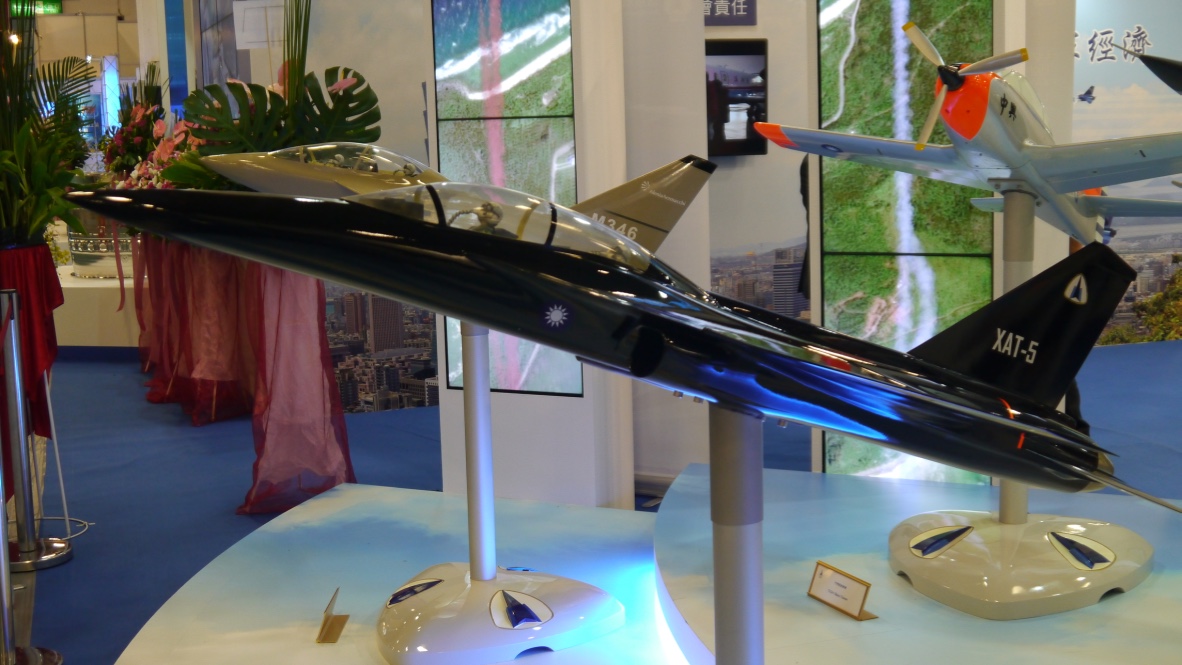
The second model,  based on AIDC’s Indigenous Defense Fighter (IDF), has been dubbed the XAT-5 Advanced Trainer. It will be outfitted with reinforced landing gear, increased fuel capacity, a glass cockpit and the same F124 engine.
Both aircraft will be new builds, rather than upgrades to older aircraft, an AIDC official said. The Air Force is expected to announce a tender in the 2016-17 time frame. The exact requirements are still being worked out, but it will either be a lead-in trainer, an advanced trainer or a combination of both, he said.
AIDC also had a model of the Alenia Aermacchi M-346 Master transonic trainer on display alongside the AT-3 Max and XAT-5. The AIDC source said the Air Force might select the M-346 instead of a local buy, and AIDC wants to have a 50 percent local assembly option. Korea Aerospace Industries’ T-50 Golden Eagle supersonic trainer also is an option, the source said.

The XAT-5 Advanced Trainer is based on the AIDC’s Indigenous Defense Fighter.Photo Credit: Wendell Minnick/Staff

During TADTE, US-based Lockheed Martin announced the sale of the Sniper Advanced Targeting Pod (ATP) for its fleet of F-16A/B Block 20 fighter aircraft. According to an Aug. 13 news release, Taiwan becomes the 20th international customer to select the Sniper ATP for its precision attack requirements.  In the initial contract, Lockheed Martin will provide two Sniper ATPs and integration support to Taiwan. The company will also provide integration support of Lockheed’s LANTIRN navigation and targeting pods on Taiwan’s F-16s.
“With Sniper ATP, pilots will have access to unmatched imagery for precision targeting and non-traditional intelligence, surveillance and reconnaissance efforts, enabling greater overall mission success,” Marc Nazon, Sniper ATP international program manager at Lockheed Martin Missiles and Fire Control, said in the news release.
Taiwan’s fleet of 146 F-16s is undergoing a midlife upgrade that will include new avionics, structural reinforcements and active electronically scanned array (AESA) radar. Lockheed was selected as the system integrator for the upgrade, and Northrop Grumman’s scalable agile beam radar will provide for the AESA requirement.

Source: defensenews

Friday, 9 September 2016

Air Force: Solving Tech Transfer Issues Crucial to Potential F-16 Production Line Move to India


By: Valerie Insinna, September 8, 2016 (Photo Credit: Senior Master Sgt. Edward Snyder/USAF)

WASHINGTON — The issue of technology transfer is likely to be the sticking point on whether the US government sanctions the potential move of Lockheed Martin’s F-16 production line to India, the Air Force’s top civilian said Wednesday.

Fresh off an August trip to the Asia-Pacific region with stops at India, Singapore, Indonesia and the Philippines, Air Force Secretary Deborah Lee James told reporters she discussed the possible sales of F-16s and Navy F/A-18s with Indian defense officials to help promote the US defense industry and further military cooperation between the two nations. Both Lockheed and Boeing, which produces the F/A-18, have proposed moving production to India in the hopes of attracting new sales of two fighter jets whose days are numbered.

James said her discussions with Secretary of Defense Production Askok Kumar Gupta, Air Chief Marshal Arup Raha and Vice Chief of Air Staff Air Marshal Birender Singh Dhanoa did not go into the details of the industry proposals. However, the talks did touch on technology transfer issues, something that she said was seen as crucial for finalizing a possible deal.

“Obviously technology transfer is something that India is really, really hoping for [and] looking for,” she said. “So how much we're able to work through will probably be a key determinant.

“And also I think a key determinant in what India ultimately ends up doing will relate to the Make in India part — how many jobs, what sorts of technologies might transfer,” she said, referring to Indian Prime Minister Narendra Modi’s effort to expand the country’s manufacturing sector.

Boeing and Lockheed have made buying fighter jets a condition of any possible deal to move production to India. The country is also considering other fighter jets, such as Saab’s Gripen and the Eurofighter Typhoon. Notably, James said Indian officials did not express interest in the US Air Force’s newest fighter, the F-35, which has amassed 10 international customers so far.

She added that she did not expect India to come to a decision for at least a year.

Given the age of the aircraft and the focus on selling the F-35, it makes sense that Lockheed would willing to move its production line in exchange for one last big sale, said Richard Aboulafia, an aerospace analyst with the Teal Group. However, the Indian government has been continuously indecisive, making a deal unlikely, he said.

“On the US side, it could be a tech transfer issue” that keeps a deal from happening, “but I doubt it,” he said. “I think in the US, they’ve realized that this stuff is not exactly F22 territory. The bigger issue is just Indian contracting uncertainty.”

Outsourcing elements of production, or even creating a separate line, is not a novel move, he said. In the past Lockheed has established such agreements with F-16 customers such as Turkey, South Korea and — most ambitiously, with Japan’s F-2 —  an F-16 derivative that split manufacturing between Lockheed and Mitsubishi.

Although current F-16 deliveries end in 2017, the company believes it will be able to net further foreign sales to sustain the production line until 2021, Randy Howard, Lockheed’s director of F-16 business development, said in an emailed response.

Asked whether moving the production line would become prohibitively expensive after that point, Howard said Lockheed was confident it would be able to set up a line in India when given the go-ahead, although the timeline would depend “on a number of factors.”

Negotiations with the US and Indian governments are ongoing, but if a deal is reached, Lockheed may also be willing to expand Indian companies’ participation in the program at a supplier level, he said.

“Under our current proposal, Lockheed Martin is offering India the exclusive opportunity to produce, operate and export F-16 Block 70 aircraft,” he said. “We also foresee significant Indian participation in the F-16 supply chain based on Indian industry’s capacity to offer best value F-16 supply chain options.”

Original post: defensenews

Related latest post:

India, Russia discuss $4 billion deal for 4 stealth frigates


By Rajat Pandit, TNN | Sep 08, 2016, 03.48 PM IST
NEW DELHI: In what could turn into yet another mega defence deal with Russia, bilateral negotiations have gained momentum for India's acquisition of four more stealth frigates for around $4 billion.

Even as the high-level India-Russia Military Technical Cooperation Working Group (MTC-WG) kicked off its two-day meeting here on Wednesday , defence ministry sources said Moscow has submitted "a techno-commercial proposal" for the four multi-purpose frigates packed with sensors and weapons, including the BrahMos supersonic cruise missiles.

"Under the proposal, two of the frigates will come from Russia, while the other two will be constructed in India. The MoD has asked for some clarifications before taking a decision on the price and inter-governmental agreement," said a source.

The MTC-WG also discussed other pending mega defence projects like the joint development of the fifthgeneration fighter aircraft and Kamov Ka-226T light utility helicopters as well as the Rs 39,000 crore purchase of five S-400 Triumf advanced air defence missile sy stems, as was reported by TOI on Wednesday .

Russia has apparently dovetailed the frigate project -which was first offered by Russian President Vladimir Putin to PM Narendra Modiover a year ago -with India's aim to lease a second nuclear-powered submarine for around $1.5 billion.

The first nuclear-powered Akula-II submarine INS Chakra -being operated by India since April 2012 after paying $900 million -had also been linked to the bigger $2.33 billion deal for aircraft carrier INS Vikramaditya.

If the deal for the four new 4,000-tonne frigates is indeed inked, they will add to the six Russian stealth frigates already inducted by India. First, three Talwar-class frigates were inducted from Russia in 2003-2004.

They were then followed in 2011-2013 by three Teg-class frigates under a $1.15 billion contract inked in 2006. India is quite satisfied with the Teg-class frigates, which have an operating range of 4,500 nautical miles and can handle threats in all three dimensions -air, surface and underwater.

But a major problem with the new upgraded Teg or Grigorivich-class frigates on offer is that the warships -lying half-constructed at the Yantar Shipyard in Russia due to a cash-crunch -will need Zorya gas-turbine engines from Ukraine.

"Ukraine has refused to supply power plants to Russia because of their continuing bilateral problems. But India can directly acquire the engines from Ukraine," said a source.

India, of course, has begun to construct its own stealth warships, having inducted three 6,100-tonne Shivalik-class frigates. Another Rs 50,000 crore contract for construction of the seven `Project-17A' stealth frigates -four at Mazagon Docks at Mumbai and three in GRSE at Kolkata -was inked in February 2015.

The Navy currently has around 130 warships as well as 235 aircraft and helicopters. Moreover, the seven P-17A frigates are among the 39 warships and six Scorpene submarines under construction in Indian shipyards for over Rs 3 lakh crore.

But India is now eyeing the Russian frigates since it plans a 212-warship Navy by 2027 to ensure effective safeguarding of its huge geostrategic interests from Persian Gulf to Malacca Strait and beyond.
Original post: economictimes
Related post:

Russian experts upbeat about export prospects for the PAK FA


6 September 2011 RBTH, WWW.AVIAPORT.RU
Russia promises to manufacture 1,000 PAK FA fighter jets by 2050 as part of a joint Russian-Indian program.
According to the forecasts of Russia’s Centre for Analysis of World Arms Trade (CAWAT), the Prospective Airborne Complex of Frontline Aviation (PAK FA) production program will result in the manufacture of at least 1,000 fighter jets by 2050.
Russia and India are the current partners in the PAK FA program. The Russian Air Force is expected to order between 200 and 250 units. High-ranking Indian military commanders have already said that their country anticipates ordering 250 jets.
According to CAWAT experts, potential buyers of the PAK FA’s export version include Algeria (projected purchasing period: 2025-2030), Argentina (2035-2040), Brazil (2030-2035), Venezuela (2027-2032), Vietnam (2030-2035), Indonesia (2028-2032), Iran (subject to lifting of the arms embargo, 2035-2040), Kazakhstan (2025-2035), China (subject to certain conditions, 2025-2035), Malaysia (2035-2040), and Syria (2025-2030).
CAWAT estimates that the possible order from these countries will total 274-388 units.
Exports of the fifth-generation Russian-Indian fighter aircraft could go well beyond the geographical area represented above, in particular thanks to orders from CIS countries. Some Western European countries could also ultimately become purchasers of the PAK FA’s export version once it is adapted to meet their needs.
According to CAWAT experts, the stated technical specifications of the new Russian fighter match those of the American F-22, today’s most advanced fighter aircraft whose mission is to ensure air supremacy.
Colonel General Alexander Zelin, commander-in-chief of the Russian Air Force, recently announced that the first batch of fifth-generation fighters will go into commission in 2014–2015.
Two prototypes are already undergoing flight-testing, and two more PAK FAs are scheduled for testing by the end of 2011, says the head of Russia’s United Aircraft Corporation.
Original post: rbth

Royal Thai Air Force need to acquire the PAK FA as it is the cheapest option for a 5th gen fighter if true according to price quoted to India approximately $240 million which is cheaper than a Rafale and way cheaper than the less capable F-35.

The article states Indonesia as a potential customer I highly doubt that as Indonesia is investing with S.Korea in the latter stealth fighter program.

Other doubtful on the list are Argentina, Brazil & Venezuela.

Related post:

Russia Defense Ministry Unveils First Video of Amazing Next Gen T-50 Fighter Jet

Sukhoi Pak Fa T-50 (Su-50): Details

Thursday, 8 September 2016

Thai lawmakers give military US$124m budget hike


Posted 08 Sep 2016 20:04 Updated 08 Sep 2016 20:10
BANGKOK: Thailand's military-appointed lawmakers on Thursday (Sep 8) signed off on a nearly US$124 million budget hike for defence spending, while funds for education and infrastructure were pared back.
The army seized power from the civilian government in 2014, saying it was forced to act to end bloody street protests and rampant corruption.
The army, navy and air force will receive a two per cent raise taking next year's spending to 210.7 billion baht (nearly US$6.1 billion), according to the budget endorsed by the hand-picked National Legislative Assembly.
The budget comes into effect next month and runs until September 2017. It is the third straight year of rises in state spending for defence since the coup.
Thailand's royalist military has for decades been at the centre of politics, battering down the country's nascent democratic movements.
Each coup has broadly been followed by a handsome budget hike, while the civilian leaders who have governed intermittently have also lavished cash on the powerful military hoping to curry favour.
The budget for education was given a 4.7 per cent haircut to 493 billion baht (US$14.1 billion) and transport was cut by two thirds from US$136 billion baht to $63.5 billion.
"This budget will be spent based on laws and rules to maintain the country's fiscal discipline," Wisanu Krea-Ngam, deputy prime Minister, said in televised comments at the end of the vote, promising the budget allocation had been carefully considered.
Experts say the budget follows a pattern that has seen defence spending creep up from around US$5.7 billion a year before the coup.
"Perhaps the rise does not appear to be breathtaking but the amount of spending is remarkable - really more than ever before," said Paul Chambers a Thailand-based expert on the military, adding it was unclear how the spending had been justified.
After years of impressive growth, Thailand's economy is faltering, mired in high household debt, stuttering exports and low consumer confidence. The army's influence in Thai politics has been embedded in a new constitution written by junta appointees.
- AFP/ec
Original post: channelnewsasia

The usual western propaganda they fail to mention that Thailand has one of the highest education budget and one of the lowest military budget in the world. (See below)
I also support that the Armed forces budget should be increase to $8 billion as the current budget is insufficient.

Government Budgets: Education vs Military Spending [infographic]


Each country has its own spending needs that vary with the priorities of the size of the population, age of the population and political involvements of that country. Some of the largest expenditures of governments are the military, health care and education. At a time when cutbacks are being made across the world in order to reduce countries deficits and attempt to stop the world slipping back further into recession, there is the concern about how countries actually spend their money. How do they decide what sectors receive the most money? Each country decides what is important in relation to its size, population of the country, the age of those residing in the country and on the political involvements of the country. You would like to think that your country would spend more on Education than the likes of Warfare, and while some countries do, others place warfare spending above that of spending on health and education.
This information supplied by Visual Economics and presented through this graphic by Coupon Code highlights these priorities on some of our world’s major countries.
Source: urbanpeek
Countries by Military expenditures (% of GDP) in 2014
Source: wikimedia