Saturday, 16 July 2022

Frigate Rheinland-Pfalz Commissioned in Wilhelmshaven

Frank Schlünsen / shipspotting.com


July 12, 2022 


On Wednesday, July 13, 2022 at 2 p.m., the German Navy will commission the frigate “Rheinland-Pfalz”, the last of four frigates of the Baden-Württemberg class F125 in Wilhelmshaven.

“The fourth and final commissioning of the F125 class represents another important milestone for our squadron and the Navy,” explains the Commander of the 4th Frigate Squadron, Captain Dirk Jacobus (53). “This means that for the first time all four ships are in the Navy’s area of ​​responsibility. With the takeover of the last F125 in the Navy, we gain an additional means for the targeted training of all our crews,” said the commander.

By order of the Deputy Inspector of the Navy and Commander of the Fleet and Support Forces, Vice Admiral Frank Lenski (60), Commander Stefan Rappelt (44), Commander of the F125 “Charlie” crew, will commission the frigate. With the commissioning of the frigate “Rheinland-Pfalz”, the crew of the F125 “Charlie” is already bringing the second of a total of four Class 125 ships into service with the German Navy, and at the same time completes the phase of introducing and testing this new class of ship “, explains frigate captain Rappelt. “That’s why the crew is pleased about this success for the German Navy and about the upcoming tasks on board the Navy’s newest ship,” said the commander.

The “Rheinland-Pfalz” now completes the squadron of the F125 alongside the “Baden-Württemberg”, “Nordrhein-Westphalen” and the “Sachsen-Anhalt”. As a highly modern and hard-wearing ship, the frigate can remain in the operational area for up to two years, regardless of its home port, and thus increase the efficiency of the fleet. Also, due to the high degree of automation, the personnel approach is reduced by almost half compared to the previous frigates. The main task will be maritime surveillance in crisis regions and the support of special forces from the sea.

Even with the F122 frigate class there was a “Rhineland-Palatinate” that made the federal state known on the seven seas. The close connection and lively sponsorship between the federal state of Rhineland-Palatinate and the crews of the ship will be revived when the new “Rheinland-Palatinate” is put into service.

#####

F125 Baden-Württemberg Class Frigate: Details

#german #germannavy #frigate #f125 #ship #warship 

JASDF C-2 No. 215 participates in Royal International Air Tattoo - YouTube

KANTO61さん


JASDF 402nd Squadron C-2 No. 215 is the newest aircraft delivered to the Air Self-Defense Force.

Currently, three C-2 transport aircraft belong to the Iruma base and are active every day.


Kawasaki C-2: Details

#japan #japanairforce #royalinternationalairtattoo #c2 #plane #transportplane

Thursday, 14 July 2022

US Army wraps up first tests for new engine for Apache and Black Hawk helicopters

U.S. Army photo / Maj. Robert Fellingham


By  Loukia Papadopoulos

Jul 08, 2022 (Updated: Jul 08, 2022 19:08 EDT)  

US Army wraps up first tests for new engine for Apache and Black Hawk helicopters

guvendemir/iStock

The U.S. Army successfully completed the first round of tests for its T901 Improved Turbine Engine Program (ITEP) engine that will now be used on the AH-64 Apache attack helicopters, the UH-60 Black Hawk choppers and the Future Attack Reconnaissance Aircraft, according to a statement released on Thursday.

Over 100 hours of run time

The T901 ITEP engine was built by General Electric in February of 2019. The company obtained a $517 million award to develop it, beating out the Advanced Turbine Engine Company — a Honeywell and Pratt & Whitney team. The completion between the companies for the engine was a decade-old ordeal. The result was a significantly more powerful engine.

According to initial reports, the engines GE delivered are operating well. "On 28 June the Army’s Aviation Turbine Engines (ATE) Project Office ITEP concluded First Engine to Test (FETT) of the very first GE built T901 engine for Army Aviation," the Army said in its statement. "FETT initial light off occurred on 22 March and the testing consisted of over 100 hours of run time. The event successfully verified and validated performance models on the Army’s next generation rotorcraft engine that will power the Boeing AH-64 Apache, the Sikorsky UH-60 Black Hawk and the Future Attack Reconnaissance Aircraft (FARA)," according to the service branch.

The new engines will give the military new capabilities that are essential for future operations.

'The T901 is the Army’s new 3,000 shaft horsepower center line engine designed to fit the existing nacelle of the Apache and Black Hawk and is also the engine for FARA. The T901 provides the critical capability that will allow Army Aviation greater reach and lethality to dominate and win in Multi-Domain Operations versus Near-Peer Competitors by providing increased power, improved reliability and better fuel efficiency," further noted the statement.

Tests delayed due to coronavirus pandemic

The tests for the engine took longer than expected as the coronavirus pandemic caused schedule slips that influenced the FARA competitive prototyping effort which requires the ITEP engine to fly. Bell and Lockheed Martin were chosen to build the FARA prototypes with the ITEP engines.

Both firms have stated that they are on track to complete the build of their prototypes and that they have been using 3D printed ITEP engines in place of the real ones until the Army delivers those. All parties involved are seeking to achieve the first flight milestone by the end of 2023.

"Preliminary Flight Rating testing will initiate this fall, continuing through 2023, and includes eight T901 engines tested to Army Military Airworthiness Certification Criteria (AMACC) standards. These standards ensure an engine meets Army requirements for design, production, and continuing airworthiness and will encompass approximately 1,500 engine test hours. In total the T901 will undergo nearly 5,000 hours of testing to achieve full engine qualification," read the Army's statement.

Ultimately, the engine is meant to deliver improved power, reliability, and fuel efficiency to the Army’s fleet of helicopters.

#####

GE begins testing onfirst T901 turboshaft engine for U.S. Army


UH-60M: Details
Ah-64 Apache: Details

#us #usarmy #ah64 #uh60 #apache #blackhawk #ge #t901 #helicopter

Gripen C/D and F-16V shortlisted in Philippine fighter procurement project

JK_._Photography


By Khalem Chapman  7th July 2022

The Philippine Air Force (PAF) revealed on July 5 that it has shortlisted the Lockheed Martin F-16V Block 50/52 Fighting Falcon and Saab JAS 39C/D+ Gripen for its Multi-Role Fighter (MRF) procurement project, adding that it is in the process of choosing between the two.

A part of Horizon Two of the Armed Forces of the Philippines Modernization Program, the MRF project seeks to acquire at least 12 fourth-generation (or higher) multi-role fighters that are capable of patrolling the nation’s airspace and protected waters, as well as for external defence activities. The selected platform will be acquired to augment the PAF’s existing fleet of 12 Korean Aerospace Industries (KAI) FA-50PH light combat aircraft, which were acquired from 2015 to 2017.


Saab's JAS 39C/D+ Gripen is one of two fourth-generation multi-role fighters to be shortlisted in the PAF's Multi-Role Fighter procurement project. Saab/Linus Svensson


While the MRF project has been approved and the PAF has narrowed down its decision to either the F-16V Block 50/52 or the JAS 39C/D+, the Philippine government has yet to allocate the necessary funds required for any prospective purchase. The PAF hopes to be able to sign an acquisition contract for its desired platform before the end of this year, according to Lt Gen Connor Anthony Canlas Sr, chief of the Philippine air arm.

Commenting on the MRF project to the Philippine News Agency (the Philippine government’s official news agency), Col Maynard Mariano – a PAF spokesperson – confirmed that the F-16V Block 50/52 and the JAS-39C/D+ were the two remaining contenders of the MRF project. “For the MRF, the project is approved with the issued Acquisition Memorandum Decision, the government will still find a way to fund the said project,” he added.

According to the Philippine News Agency, the MRF project calls for a solution that is able to integrate “with existing radar systems that have a range of about 250nm.” It adds that the PAF, “with the help of these radar systems, can be deployed to determine whether the aircraft flying over the country’s airspace is friendly or hostile.”


The other contender in the PAF's Multi-Role Fighter procurement project is Lockheed Martin's F-16V Block 50/52 - a variant of the latest and most advanced version of the Fighting Falcon family produced to date. Lockheed Martin


The US-built F-16V (known as the ‘Viper’) is the latest and most advanced variant of the Fighting Falcon family to date. It features enhanced systems, such as the AN/APG-83 active electronically scanned array (AESA) radar that caters for greater detection and tracking capabilities, along with a variety of air-to-air/ground munitions. Given that the F-16 is operated by a number of air arms in the Asia-Pacific region, selecting the F-16V would also give the PAF an ability to integrate with other regional allied air forces, enabling greater commonality and cooperation.

On the other hand, Sweden’s JAS 39C/D+ Gripen is well-suited for dispersed operations, as it requires minimal personnel and ground support equipment to be operated effectively. While it is not in widespread use in the Asia-Pacific region – like the F-16 – the fighter can be employed from small, unprepared roads and highways. It is also fitted with a sophisticated AESA radar system and comes with an advanced sensor/weapons package.


Tuesday, 12 July 2022

Lockheed Martin to buy 22 electro-optical sensors to give F-35 pilots a spherical view of the environment

U.S. Air Force photo / Capt. Kip Sumner


DAS collects real-time imagery from six infrared (IR) cameras mounted around the aircraft and sends it to the pilot’s helmet-mounted display.

John Keller

Das 7 July 2022


PATUXENT RIVER NAS, Md. – Combat aircraft experts at Lockheed Martin Corp. will buy 22 360-degree electro-optical sensor systems for the U.S. F-35 joint strike fighter under terms of a $22.6 million order announced on Tuesday.

Officials of the Naval Air Systems Command at Patuxent River Naval Air Station, Md., are asking the Lockheed Martin Aeronautics segment in Fort Worth, Texas, to procure 22 Electro-Optical Distributed Aperture System (DAS) sensors for the F-35 systems technology refresh-3.

The contract also calls for Lockheed Martin to procure developmental and operational testing, block 4 testing, the Electromagnetic Environmental Effects aircraft, and a spare sensor set for F-35 next-generation capabilities.

The electro-optical DAS collects real-time, high-resolution imagery from six infrared (IR) cameras mounted around the aircraft and sends it to the pilot’s helmet-mounted display, providing a 360-degree spherical view of the environment.

The next-generation electro-optical DAS is from the Raytheon Technologies Corp. Intelligence & Space segment in McKinney, Texas. The system's original manufacturer was Northrop Grumman Corp., but the Pentagon and Lockheed Martin switched suppliers of the system to Raytheon in mid-2018.

The Raytheon-built DAS sensor system will be integrated into F-35 aircraft starting with Lot 15 aircraft, expected to begin deliveries in 2023.

The electro-optical DAS is designed to warn the pilot of incoming enemy aircraft and missiles, daylight and nighttime vision; fire control; and precision tracking of nearby aircraft for tactical maneuvering.

By projecting the DAS video stream into a helmet-mounted display, the F-35’s pilot can see through the aircraft structure to view the surrounding environment.

Lockheed Martin Aeronautics is the manufacturer of the F-35 jet fighter-bomber for the U.S. Navy, Marine Corps, Air Force, and allied air forces.


#us #usairforce #usmarine  #usnavy #f35 #lockheedmartin #stealth #plane #fighterplane #jet #fighterjet

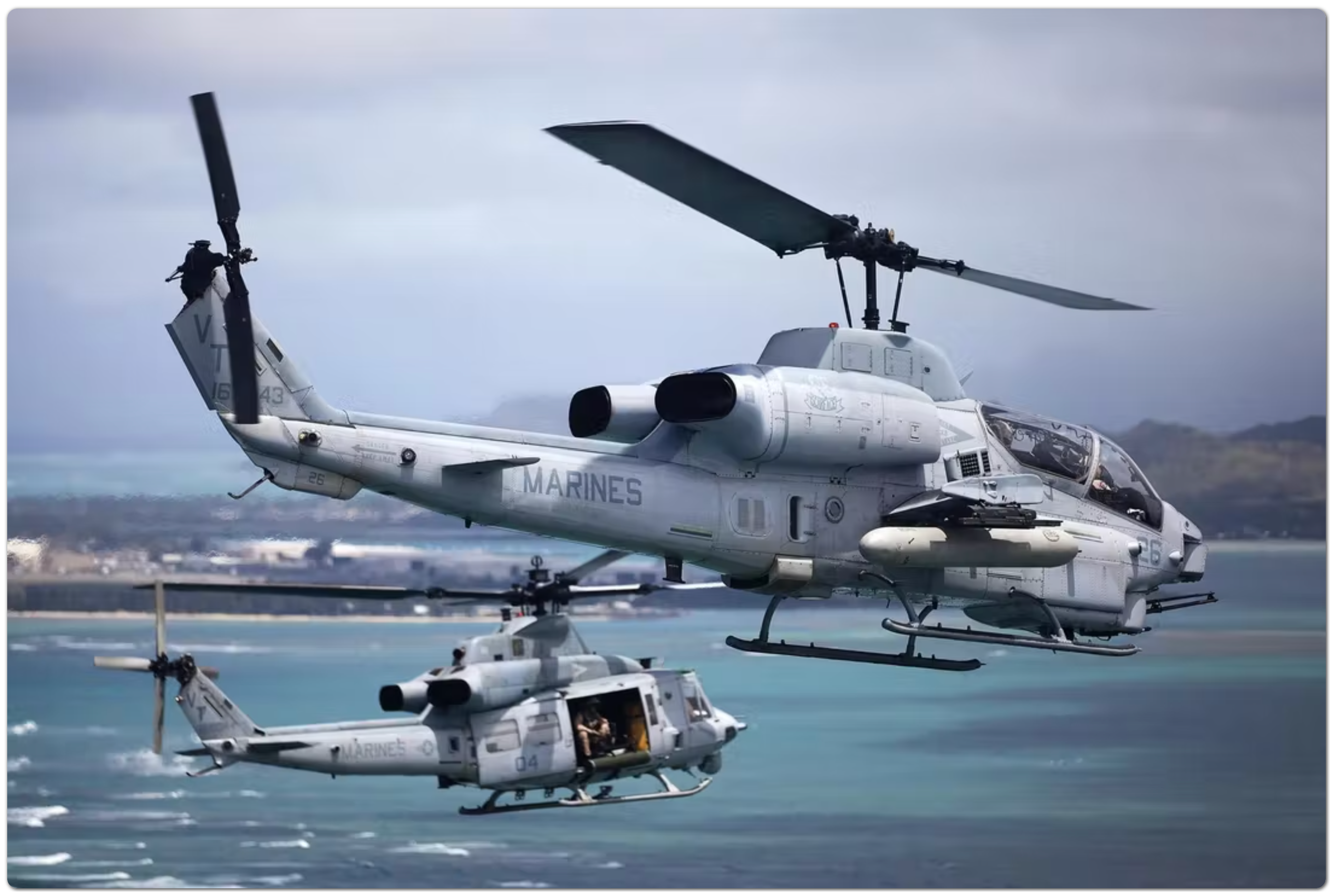
Northrop Grumman to upgrade and support avionics for the AH-1Z and UH-1Y helicopters for U.S. Marine Corps

U.S. Marine Corps photo / Sgt. Jonathon Wiederhold


John Keller

Helicopters 7 July 2022


RIDGECREST, Calif. – U.S. Navy helicopter avionics experts are asking Northrop Grumman Corp. to upgrade and support H-1 integrated avionics systems for the U.S. Marine Corps AH-1Z Super Cobra and UH-1Y Super Huey attack and utility helicopters to enhance performance, commonality, reliability, and maintainability.

Officials of the Naval Air Warfare Center weapons Division at China Lake Naval Air Weapons Station in Ridgecrest, Calif., announced a $337.9 million five-year contract Friday to the Northrop Grumman Mission Systems segment in Woodland Hills, Calif., for H-1 avionics research and development.

The H-1 Upgrade program is replacing aging AH-1W and UH-1N helicopters with upgraded AH-1Z Super Cobra and UH-1Y Super Huey attack and utility helicopters to enhance commonality, reliability, and maintainability.

Northrop Grumman will develop and test H-1 integrated avionics systems, identify maintenance capabilities, upgrade test and measurement equipment for H-1 avionics, and will investigate new capabilities and anomalies related to H-1 avionics and weapons.

Northrop Grumman manufactures, upgrades, and support the Gen III mission computers that are the heart of the company's Integrated Avionics System (IAS) that powers the glass cockpit avionics of the UH-1Y and AH-1Z helicopters. Dual mission computers provide centralized control of the IAS and display situational awareness and health monitoring information.

The Northrop Grumman conduction-cooled Gen III Technical Refresh mission computer incorporates a ruggedized 6U VME PowerPC-based single board computer. Interfaces include Fast Ethernet, four serial ports, parallel I/O, and built-in-test. FlightPro has a standard partitioned real-time operating system called INTEGRITY-178 tuMP for multicore architectures from Green Hills Software in Santa Barbara, Calif., with ARINC 653 and POSIX support.

The IAS and mission computers can accommodate future system upgrades; rapid insertion of new technologies; and integration of other avionics, communications, and survivability equipment. Northrop Grumman also provides the operational flight program software that controls the IAS.

The mission computer's standard configuration also includes a quad channel 1553 mezzanine card, high-speed serial card, digital I/O module with eight channels of opto-coupled discrete inputs, eight channels of opto-coupled discrete outputs, and 16 channels of general-purpose bi-directional discretes that can be programmed individually as outputs or inputs.

The FlightPro mission computer is capable of Required Navigation Performance/Area Navigation (RNP/RNAV) in all flight regimes, including departure, en route, terminal, and non-precision approach using GPS as the sole navigation source.

The flight computers use 28-volt DC or 115-volt AC three-phase 400 Hz input power, measure 13.61 by 11.5 by 7.55 inches, and weigh 30.4 pounds. The computers have rated 3,200 hours mean time between failures.

The flight computer software is RTCA DO-178C compliant, has ARINC-653 partitioning for safety and security, and complies with the Modular Open Systems Architecture (MOSA) standard. The software is aligned with the Future Airborne Capability Environment (FACE) technical standard, has hardware-independent application software developed to MIL-STD-498, under MIL-STD-882C safety program environmental qualification.


AH-1Z Viper: Details
UH-1Y Huey: Details

#us #usnavy #usmarine #ah1z #uh1y #helicopter #attackhelicopter

Monday, 11 July 2022

Boeing Delivers 150th P-8 Maritime Patrol Aircraft 

Michael Leek


Posted on July 7, 2022 by Seapower Staff

The newest Boeing P-8 maritime patrol and reconnaissance aircraft takes to the skies over Puget Sound, Washington. BOEING

SEATTLE — The newest Boeing P-8 maritime patrol, reconnaissance aircraft took to the skies over Puget Sound bringing the total number of P-8s delivered to 150, the company said July 7. The 150th multi-mission P-8 will be operated by Air Test and Evaluation Squadron One (VX-1) based at Naval Air Station Patuxent River, Maryland.

“There are now 150 P-8s around the world delivering confidence and an unmatched capability to our global customers,” said Stu Voboril, vice president and program manager of P-8 Programs. “Our focus has been, and will be, on delivering the world’s best maritime patrol aircraft.”

Amassing more than 450,000 mishap-free flight hours, the global P-8 fleet includes 112 aircraft delivered to the U.S. Navy, 12 to Australia, 12 to India, nine to the United Kingdom and five to Norway. First deliveries to New Zealand, Korea and Germany are scheduled for 2022, 2023 and 2024 respectively.

The aircraft are designed for antisubmarine warfare, anti-surface warfare, intelligence, surveillance and reconnaissance and search and rescue.

The 150 P-8s in service do not include six test aircraft provided to the U.S. Navy during the initial stages of the program. Boeing tested those aircraft during development to assess capabilities and performance. As development of system enhancements and new technology continues, the test aircraft perform a critical role in ensuring Boeing provides state-of-the-art capabilities to global P-8 customers.

#####


With missile upgrade, P-8A Poseidon brings capacity, complexity to China fight: Analysts


P-8 Poseidon: Details