Saturday, 13 August 2016

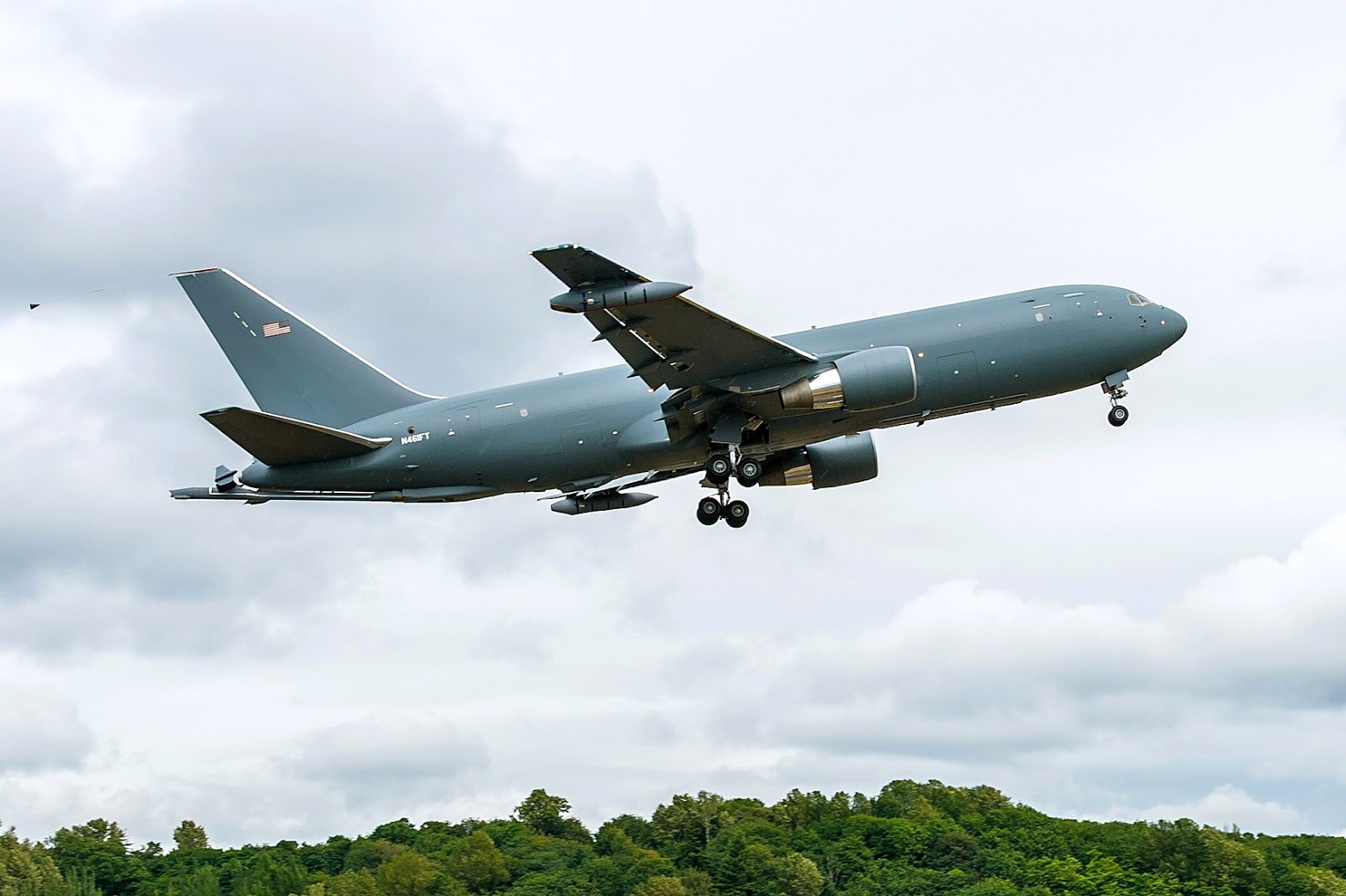
Pentagon OKs giving Boeing contract to build 19 Air Force tankers


Originally published August 12, 2016 at 4:01 pm Updated August 12, 2016 at 4:24 pm
The Air Force won permission from Pentagon officials to sign two production contracts with Boeing for the first 19 KC-46 tankers, deals valued at a combined $2.8 billion.
By
Bloomberg News
The Air Force won permission from Pentagon officials to sign two production contracts with Boeing for the first 19 KC-46 tankers, deals valued at a combined $2.8 billion.
The approval came after a meeting of the Pentagon’s Defense Acquisition Board headed by Frank Kendall, the Defense Department’s top weapons buyer. The decision was announced by the Air Force in an emailed statement.
“I commend the team for diligently working through some difficult technical challenges,” Air Force Secretary Deborah Lee James said in the statement. “The KC-46 program has made significant strides in moving the Air Force toward the modernization needed in our strategic tanker fleet.”
The decision on initial, low-rate production had slipped from August 2015 and then from April of this year to resolve technical issues with the tanker’s refueling system. The final hurdle was cleared last month with the successful refueling of an A-10 Warthog that verified Boeing fixed flaws in the boom used for in-air refueling.
Boeing is in line to produce as many as 179 tankers under the $52 billion program.
A decision to approve full production — the most lucrative phase — has slipped to March 2018 from September 2017, the Air Force disclosed in March, as a result of cumulative delays in aircraft development from technical issues, such as wiring and the refueling system.
The KC-46, built on the air frame of Boeing’s 767 commercial jet, is the first new U.S. tanker since the 1980s. Boeing said in July that it would report a $2.1 billion after-tax accounting charge for the second quarter, primarily because of setbacks involving passenger planes but also due to a $393 million loss stemming from delays on the KC-46.
Specifications

Data from USAF KC-46A, Boeing KC-767, Boeing 767-200ER

General characteristics
  • Crew: 3 (2 pilots, 1 boom operator) basic crew; 15 permanent seats for additional/optional air crew members, including aeromedical evacuation crew members
  • Capacity: seating for up to 114 people, 18 463L pallets, or 58 patients (24 litters, 34 ambulatory)
  • Payload: 65,000 lb (29,500 kg)
  • Length: 165 ft 6 in (50.5 m)
  • Wingspan: 157 ft 8 in (48.1 m)
  • Height: 52 ft 1 in (15.9 m)
  • Empty weight: 181,610 lb (82,377 kg)
  • Max. takeoff weight: 415,000 lb (188,240 kg)
  • Powerplant: 2 × Pratt & Whitney PW4062 turbofan, 63,300 lbf (282 kN) each
  • Fuel Capacity: 212,299 lb (96,297 kg)
  • Maximum Transfer Fuel Load: 207,672 lb (94,198 kg)
Performance

Defence Ministry to take a call on the purchase of Rafale fighter jets


PTI  Aug 12, 2016 18:34 IST

New Delhi: The Defence Ministry's top acquisition council is likely to take up this month the final report submitted by a team negotiating the much-anticipated Rafale fighter jet deal with France.

The Defence Acquisition Council (DAC), chaired by Defence Minister Manohar Parrikar, is likely to meet on 18 August.

The Council had last month reviewed the multi-billion Euro Rafale deal and directed the Indian negotiating team to submit its report "expeditiously".

"The negotiating team has submitted its report which is under examination," the Minister said in a written reply to the Lok Sabha on Friday.

During his visit to France in April last year, Prime Minister Narendra Modi had announced that India would purchase 36 Rafale jets in a government-to-government contract.

Soon after the announcement, the Defence Ministry scrapped a separate process that was on to purchase 126 Rafale fighter planes, built by French defence giant Dassault Aviation.

The new deal comes with the clause of delivering 50 percent offsets, creating business worth at least 3 billion Euros for smaller Indian companies and generating thousands of jobs in India through offsets.

The commercial negotiations on the pricing of the planes, equipment and other issues began in mid-January this year.


Latest related post

Arms dealer connection holds up the Rafale deal

India seeks further discount on Rafale, deal in final stages

Dassault Rafale

Friday, 12 August 2016

FLIR Footage Shows F-35's Stealth Limitations


Defense News

It’s always amazing to see complex machinery and the heat they generate through the lens of a thermal camera, the Lockheed Martin F-35 is no exception! The F-35 is a state-of-the-art stealth multirole fighter, and this particular model allows for vertical landing (as you’ll see in the “hottest” part of the video!)


This footage was captured using the FLIR Star SAFIRE 380-HDc during a flight demonstration at last month’s Farnborough International Air Show.
(EDITOR’S NOTE: The footage above illustrates why the F-35 is easily detectable despite its much-hyped radar “stealth:” it generates so much heat that it is visible at long ranges by thermal imaging sensors, such as the infra-red scan and track (IRST) sensors fitted to most combat aircraft made outside the US.
It also begs the question of how Lockheed designers – and the Pentagon -- can have believed their own “stealth” claims to the point of ignoring the F-35’s infra-red signature, which negates all gains made in the radar spectrum.
Incidentally, it also makes one wonder how US military aviation chiefs could have accepted an entire generation of combat aircraft without IRST sensors they are now belatedly trying to retrofit.
In the video, the switch from visible to thermal imaging, at the 10 second mark, is especially telling (hotter is whitest).
To coin a phrase, it stands out like a blowtorch in a dark room.
Throughout its modest flight display, the aircraft – an F-35B STOVL variant -- generated an incredible amount of heat, which makes it easily detectable from any angle by any thermal imaging sensor, including IR binoculars and sights that are widely distributed on the modern battlefield.)
-ends-


Actually this is nothing new the same goes for the F-22 but the F-35 is known to give off much more heat.  It's one of the reasons that they ban the use of IRST at any war games such as at Red Flag.  See F-22 below


Lockheed Martin F-22 details link

F-35 Lightning II details link

Dozens more F-16 fighter jets could be coming to Tucson


By David Wichner Arizona Daily Star

Tucson stands to gain up to 48 F-16 fighter jets in the next couple of years as the Air Force makes room for the next-generation F-35 Joint Strike Fighter.

On Thursday, the Air Force released a list of 34 bases around the country that could be assigned F-16 training units relocated from Luke Air Force Base near Phoenix and from Hill Air Force Base in Utah, to make room for new F-35 fighters and to address pilot shortages.

Both Davis-Monthan Air Force Base and the 162nd Wing of the Arizona National Guard, based at Tucson International Airport, are among the potential new sites.

The 162nd Wing — the Air Guard’s biggest fighter wing and the primary site for training of foreign F-16 pilots — also is on a list of four bases that could get more F-16s by the fall of 2017, under an interim plan to quickly address the shortage of pilots.

Both decisions are expected to be made by spring of 2017, according to U.S. Rep. Martha McSally, R-Tucson.

The others on that list are Luke Air Force Base in Phoenix, which is transitioning from F-16 to F-35 training; Holloman Air Force Base, New Mexico; and Joint Base San Antonio’s Kelly Air Guard Station, Texas.

Under previous force restructuring plans, the Air Force planned to move 21 Air Force Reserve F-16s to D-M in 2019 after the base’s A-10 Thunderbolt II close- air-support jet was to be retired, though the A-10 retirement plans have been pushed back three years.

Amid the move to retire the A-10, D-M in April was pegged as a finalist to house F-35 Lightning II fighter aircraft. In December 2015, the Air Force also announced D-M as a potential site for expanded remotely piloted aircraft missions.

McSally said the Air Force announcement recognizes Arizona’s “unparalleled” assets for combat fighter training.

“With thousands of square miles of high and low altitude military airspace, over 300 days of sunshine a year, and close access to the Barry M. Goldwater training ranges, there’s no better place in the country to train pilots for these missions,” McSally said Thursday in a news release.

Though F-16s periodically fly from D-M during training, the only F-16s based there are a few Air Guard F-16s on homeland-security alert duty.


Some local residents have opposed more F-16 flights here, as well as stationing F-35s here, citing increased noise, and safety and health concerns.


A Modest Arms Sale of Obsolete Aircraft to India?


AUGUST 11, 2016

There may be more to Lockheed’s Made-in-India deal than first meets the eye.

BY DANNY LAM

The US Air Force and those of other NATO countries are phasing out F-16s much sooner than anticipated. This implies that performance of F-35s has met expectations, and that there are no obvious show-stoppers to ramping up production as fast as budgets allow. The F-15, F-16, and F/A-18 production lines are all slated to close by 2020. But there is more to this deal, as it has the potential to alter the balance of power in South and Southeast Asia over the next decade.


Lockheed-Martin’s “Made in India” deal, which offers exclusive rights to manufacture and produce ‘Block 70/72’ F-16s, implies that few—if any—orders are expected from NATO countries. India will have a veto on sales to sensitive countries like Pakistan and Taiwan. This deal is being “finalized”, though no deal with India is a done deal until cash arrives on the barrelhead. But suppose it moves forward, and Indian F-16s are produced in quantity starting in 2019 or 2020. Depending on the technologies transferred or made accessible by India, there is considerable scope to update and upgrade the F-16 to achieve a degree of equivalence to stealth-by-other-means, so as to be competitive with state-of-the-art and relatively stealthy Russian and Chinese fighters. Those upgrades will likely find a ready market with the world’s F-16 operators.


India is one of the world’s largest operators of both Russian and European military equipment. The deal opens the door for India to be the only vendor in the world that can acquire the expertise and infrastructure to integrate and upgrade existing Russian, European, and American platforms. The technical and logistical challenges are formidable, and India will likely require external assistance. However, a well-integrated Indian air defense system built around numerous and inexpensive pre-5th generation aircraft, appropriately upgraded, together with a few indigenously developed items will be sufficient against likely Chinese and Pakistani threats for decades. Will India step to the challenge? Successfully fielding this capability would give India leverage in many areas.


The F-16 deal can be used as the cornerstone to develop a domestic Indian military aircraft manufacturing capability with considerable export potential. This would give China pause before risking a conflict with India, and put China on notice that its arming up Pakistan—to include the transfer of nuclear weapons know-how—is threatening India. Until now, China has not paid much of a price for this Maoist-era strategy of “the enemy of my enemy is my friend.”


Developing these technologies and capabilities can give India the option of expanding arms sales to other Southeast Asian states which presently operate a mix of poorly integrated or wholly unintegrated American, European and Russian equipment. Beyond that, there is the option of Indian arms sales to Taiwan in response to a major provocation or conflict with China. Integrating these weapons with appropriate upgrades and acquisition of a few key pieces will challenge Chinese dominance of the South China Sea. To wit, the sale of BrahMos cruise missiles fundamentally altered Chinese strategic calculations toward Vietnam. Modest sales of relatively inexpensive (at $3 million each) air-, land-, ship- and submarine-based cruise missiles to Southeast Asian states disputing the 9-Dash-Line claims would effectively make those waters a no-go zone for major Chinese surface combatants or shipping. The BrahMos and the F-16IN would thus constitute a key component of a low cost, high leverage anti-access and area denial strategy against China.

Dr. Danny Lam is an independent researcher based in Calgary. The opinions herein are the author’s.


There are errors in the author’s views!

-The F-35 induction has been delayed for decades with issues and cost overruns
-The US has large fleet of stored F-16

"The US Air Force currently retains close to 1,200 F-16s in active service - slightly more than half of their total inventory. Most of the inactive aircraft were either lost due to attrition (more than 400 airframes), or where placed in storage in the Boneyard at Davis-Monthan AFB (more than 300 airframes). The US Air Force has also managed to sell or lease a significant amount of its retired aircraft to other operators (174 F-16s). This includes a number of aircraft that were transfered to the US Navy (after being embargoed for Pakistan), and 34 F-16 ADF aircraft for Italy. Quite unique for the USAF is the heavy use of retired F-16s as ground instruction aircraft (77 aircraft). Also quite exceptional: a large number of retired F-16s end up being preserved in museums or as gateguards." Source f-16.net http://www.f-16.net/fleet-reports_article2.html

-There are little interest in new build F-16 in the market with the exception of UAE which operates the Block 60 and Pakistan which operates the Block 50
-Many countries are phasing out the F-16s so India will likely be the only operator of the Block 70
-The Block 70 won’t be cheap it would likely cost over $100 per copy as the Block 50 already cost more than $80 million per copy
-Countries looking for the same category of fighter jets would likely go for Gripen E/F which is much more advance and more capable than even the F-16 Block 70.