Monday, 2 October 2017

Plane jointly developed by China, Russia gets name

world.huanqiu.com

By Wang Ying in Shanghai | chinadaily.com.cn | Updated: 2017-09-29 21:01

The wide-body commercial jet co-developed by China and Russia was named CR929 on Friday.

During a naming ceremony held at Commercial Aircraft Corp of China (COMAC), China-Russia Commercial Aircraft International Co Ltd (CRAIC), a Shanghai-based joint venture between COMAC and Russia's United Aircraft Corp (UAC) established in May also announced the logo of the jetliner.

The letter C and R stand for China and Russia respectively, 9 is the largest single number and means long-lasting in Chinese, and 2 refers to the two parties working together in developing the aircraft.

The logo in red and blue is a combination of the dominant color of China's national flag and UAC's logo.

The joint venture is tasked to push forward the research, development, operation and sales of a wide-body aircraft in the next decade.

Research and development for the 280-seat wide-body aircraft with a range of 12,000 kilometers was launched, according to He Dongfeng, president of COMAC, at an aviation safety conference earlier this year.

Original post: chinadaily.com.cn

CR929


China's commercial long-range wide-body aircraft chief designer Chen Yingchun:

It should be said that the initial technical program to determine the basic range of 12,000 km, according to the standard three cabin, take the first class, business class, economy class, three The cabin layout is 280 seats. The maximum passenger capacity, that is, the economy class, can reach more than 400 seats, you can achieve cross-ocean flight, for example, from Beijing, we can fly directly to the west coast of the United States.

  CR929 design is known as a dual-channel wide-body aircraft, which means that passengers boarding, you can walk through the two channels in the cabin. Its takeoff weight can be close to 300 tons. In contrast, just the first flight of the large aircraft C919 aircraft cabin only designed a walking channel, so called single-channel narrow-body aircraft. In addition, CR929 also retains the C919 emphasis on ride comfort design. Source: world.huanqiu.com

Source: wikiwand.com

Textron Airborne Solutions buys 63 Mirage F1s

Image – from the net

Textron unit acquires 63 Mirage F1s

19 SEPTEMBER, 2017 SOURCE: FLIGHTGLOBAL.COM BY: LEIGH GIANGRECO WASHINGTON DC

As Textron Airborne Solutions pursues the US Air Force’s lucrative adversary air (ADAIR) contract, the company earlier this month acquired 63 Dassault Mirage F1s, ATAC chief executive Jeffrey Parker tells FlightGlobal.

ATAC, which Textron acquired last year, took ownership of the legacy fleet, plus support equipment and 150 engines, on 5 September. Textron plans to use the Mirages towards the USAF’s upcoming award, which requires almost 150 aircraft to fulfil the service’s "red air" training needs.

"Textron is planning to retrofit the F1s with modern avionics systems such as digital radio frequency memory jamming capabilities and upgraded radars, Parker says. “The requirements we're seeing the air force describe clearly include a modern radar such as AESA or a highly capable mechanically scanned array radar."

While the 63-aircraft fleet marks a significant acquisition for a private company, Textron is still searching for additional aircraft to satisfy the USAF’s requirements. However, the company’s options have started waning as it looks for aircraft that can operate for more than a decade or have parts that can be supported at the manufacturing level, Parker says. The field is also narrowing in Europe, and Textron has effectively stopped buying from former Eastern Bloc countries for the time being.

“There are aircraft from eastern Europe that our warfighters would train against, but they do not have a good track record for supportability, documentation and airworthiness certification, which has become important for industry now,” he says. “When you start checking off the things that make aircraft attractive, they start falling away, for those reasons, for politics, and for State Department issues where you cannot buy aircraft from different countries.”

The ADAIR award, estimated at $7.5 billion over ten years, would contract out nearly 37,000 flight hours to provide adversary air services, filling the gaps at the USAF’s 57th Wing weapons school and Red Flag training events, as well as operational test and evaluation missions at Nellis AFB, Nevada. The USAF expects to release a final solicitation in January 2018, with a contract award due the following year.

The air force issued a short-term contract to Draken International in 2015, following the closure of the 65th Aggressor Squadron at Nellis AFB and deactivation of the base’s 19 Boeing F-15s, which had performed red air missions. The one-year, $4.5 million contract signalled a broader shift from organic adversary air provision by USAF pilots to a contracted capability.

“In a perfect world we would have the resources to maintain the aggressor squadrons that we used to have, and we’d do our best to work in house,” Air Combat Command chief Gen Mike Holmes said during the annual Air, Space and Cyber conference near Washington DC. However, he notes: “In the world we’re living in now, I don’t want to have to trade an actual fighter squadron for an aggressor squadron because of limits on my budget. The next best thing is to see if we can contract some of that red air out.”

However contracting out adversary air missions is a temporary measure, and Holmes says the USAF has plans in its budget to return to an organic capability. The contract is still likely to last more than a year, he adds. One possibility to extend the air force’s resources is to create a derivative of its future T-X trainer, after its Air Education and Training Command gets that programme off the ground.

An earlier version of this story incorrectly stated the contract award estimate

Original post: flightglobal.com

Related post:


ATAC website: Here

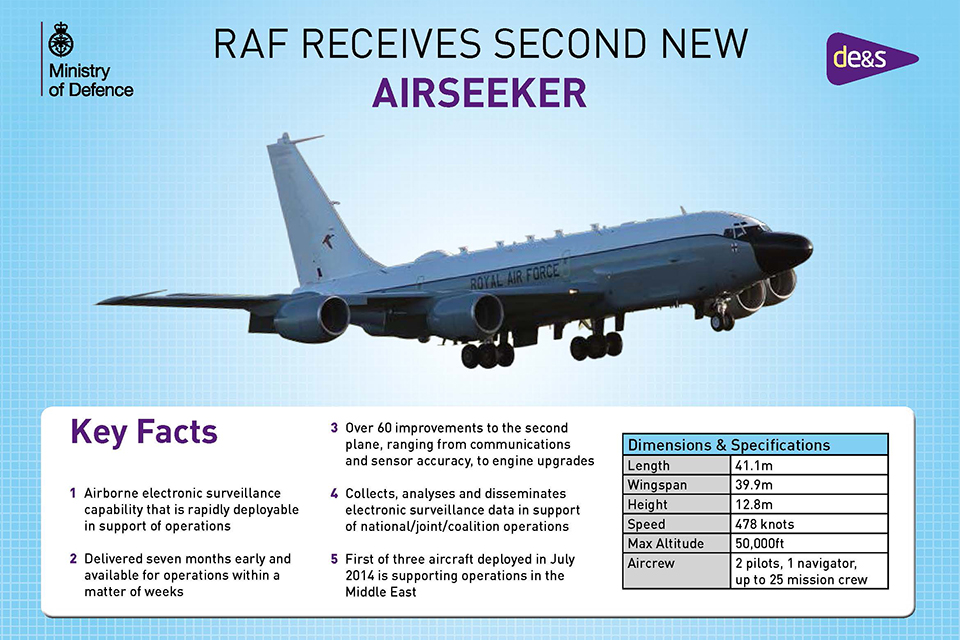
L3 Successfully Delivers Final Airseeker to U.K. Royal Air Force

Image: Crown Copyright

– Major Program Milestone Achieved –

NEW YORK--(BUSINESS WIRE)--Sep. 28, 2017-- L3 Technologies (NYSE:LLL) announced today that it has successfully delivered the third and final RC-135V/W Rivet Joint (RJ) signals intelligence aircraft to Britain’s Royal Air Force (RAF), a milestone marking the completion of the historic U.S. Air Force (USAF) and U.K. Ministry of Defence (MOD) Airseeker program.

The three U.K. RJ aircraft form the backbone of the U.K.’s Airseeker capability, providing new and collaborative intelligence, surveillance and reconnaissance (ISR) resources in support of global security missions. Upon touchdown at Royal Air Force Waddington, Lincolnshire, U.K., the aircraft was formally transferred to the RAF, completing the hardware deliveries under the Foreign Military Sales contract valued at approximately $1 billion.

Taken together, the U.K. RJ and USAF RJ aircraft form a combined fleet of 20 aircraft, and L3 will perform future baseline upgrades and periodic depot maintenance on the fleet. L3 has also delivered a station to support ground operations and training systems to train both operators and maintainers.

“This groundbreaking agreement gives the U.K. access to future innovative technology and presents a very high level of interoperability with major coalition partners,” said Christopher E. Kubasik, L3’s President and Chief Operating Officer. “This partnership has provided our U.K. allies with an intelligence-gathering platform that supports near-real-time on-scene collection, analysis and dissemination capabilities.”

“Analysts have hailed this U.K./U.S. program as the highest level of intelligence cooperation between the two countries since World War II,” said Mark Von Schwarz, L3’s Senior Vice President and President of its Aerospace Systems business segment. “The U.S. and the U.K. will be closely involved in future maturation of the Rivet Joint weapon system for at least the next 25 years.”

Under the agreement, the U.K. purchased three Rivet Joint aircraft for conversion by L3 from KC-135R tankers to the RC-135W configuration. The first two aircraft were delivered in 2013 and 2015, respectively, and upon gaining their airworthiness releases.

“The cooperation between L3, the USAF and the U.K. MOD throughout the Airseeker program has been the key to delivering aircraft early and fielding the capability ahead of the original schedule,” said Bill Chrispin, the U.K. MOD’s Airseeker Delivery Manager.

Headquartered in New York City, L3 Technologies employs approximately 38,000 people worldwide and is a leading provider of a broad range of communication, electronic and sensor systems used on military, homeland security and commercial platforms. L3 is also a prime contractor in aerospace systems, security and detection systems, and pilot training. The company reported 2016 sales of $10.5 billion.

To learn more about L3, please visit the company’s website at www.L3T.com. L3 uses its website as a channel of distribution of material company information. Financial and other material information regarding L3 is routinely posted on the company’s website and is readily accessible.

Safe Harbor Statement Under the Private Securities Litigation Reform Act of 1995
Except for historical information contained herein, the matters set forth in this news release are forward-looking statements. Statements that are predictive in nature, that depend upon or refer to events or conditions or that include words such as “expects,” “anticipates,” “intends,” “plans,” “believes,” “estimates,” “will,” “could” and similar expressions are forward-looking statements. The forward-looking statements set forth above involve a number of risks and uncertainties that could cause actual results to differ materially from any such statement, including the risks and uncertainties discussed in the company’s Safe Harbor Compliance Statement for Forward-Looking Statements included in the company’s recent filings, including Forms 10-K and 10-Q, with the Securities and Exchange Commission. The forward-looking statements speak only as of the date made, and the company undertakes no obligation to update these forward-looking statements.
View source version on businesswire.com: http://www.businesswire.com/news/home/20170928005657/en/
Source: L3 Technologies
L3
Corporate Communications
212-697-1111

Original post: l3t.com


gov.uk

China's J-20 stealth fighters put into service


2017/10/01 23:26:06

Taipei, Oct. 1 (CNA) China's most advanced Chengdu J-20 stealth fighter has been officially commissioned into service, the country's defense ministry has recently confirmed for the first time, making China the second nation in the world, after the United States, to have an operational fifth-generation fighter jets.

China's Ministry of National Defense spokesperson Wu Qian (吳謙) also told a press conference on Sept. 28 that flight tests of J-20s were being conducted as scheduled.

In an interview with China's CCTV, Yin Zhou (尹卓), a People's Liberation Army (PLA) Navy rear admiral, said that the commissioning of the J-20 into service with the PLA Air Force (PLAAF) meant that the stereotyped model is currently in initial production.

After the PLAAF receives the fighter jets, the air force needs to have its new generation of pilots trained in flight testing of the aircraft and to assure proper operation of specific systems with reference to applicable flight and maintenance manual, Yin said, adding that only when the work is up to the standards in the manual will China begin mass production.

Yin said there were about 10 J-20s serving in the PLAAF and China could build hundreds of the fighter jets based on its military needs, economic situation and production capability.

Given that the entry of the J-20 into the PLAAF would provide China with a variety of previously unavailable air combat options, Yin said it's likely that the combat aircraft could be deployed to areas in desperate needs to address potential conflicts, particularly in China's east coast area and South China Sea.

The J-20 is the fifth-generation fighter aircraft developed by China's Chengdu Aerospace Corporation. It was previously reported that initial production began in 2016 and a number of the planes were delivered to the PLAAF in December that year.

(By Ozzy Yin and Shih Hsiu-chuan)
Enditem/sc

Original post: focustaiwan.tw

Related post:


Chengdu J-20: Details

Sunday, 1 October 2017

Indian Air Force bases in Ambala being readied for Rafale jets

Image – from the net

Ambala, Hasimara IAF bases being readied for Rafale jets

The Indian Air Force has initiated major infrastructure upgrade at its frontline base in Ambala for deployment of the first squadron of the Rafale jets

Ambala: The Indian Air Force has initiated major infrastructure upgrade at its frontline base in Ambala for deployment of the first squadron of the Rafale jets which will give India greater “potency” over Pakistan as these will be capable of carrying nuclear weapons and other missiles.

The government has already sanctioned Rs220 crore to set up 14 shelters, hangers and maintenance facilities at the 78- year-old base for the Rafale jets whose delivery is scheduled to begin from September 2019, a senior IAF official said. “We are creating infrastructure keeping in mind infrastructure requirement for the Rafale jets for next 40-50 years,” the official said on condition of anonymity as he is not authorised to speak to media.

The Ambala base is considered one of the most strategically located bases of the IAF as the Indo-Pak border is around 220 km from it. Currently, the base has two squadrons of the Jaguar combat aircraft and one squadron of the MiG-21 Bison.

Marshal of the IAF Arjan Singh, who passed away two weeks ago, was the first commander of the Ambala base in independent India.

Several teams from French defence major Dassault Aviation, the manufacturer of Rafale, have already visited the Ambala air force base and finalised the requirement for the first squadron of combat jets. The IAF is also carrying out infrastructure upgrade at its Hasimara base in West Bengal which will house the second squadron of the Rafale jets, the official said.

In September last year, India had signed a €7.87 billion (approx Rs59,000 crore) deal with the French government for purchase of 36 Rafale fighter jets. Eighteen Rafale jets will be deployed in Ambala while an equal number of the new generation jet will be stationed in Hasimara.

“We are planning to put in place all required infrastructure for Rafale squadron by end of next year,” said the IAF official. The Ambala as well as Hasimara stations will also have simulator-based training facilities for the air crew of Rafale jets.

The IAF has already selected a batch of pilots to fly the jets and they are being given training by Dassault Aviation in France. The Rafale squadron to be deployed in Ambala will be known as Golden Arrows which was originally based in Bhatinda and was disbanded two years ago.

The Rafale combat jets will come with various India- specific modifications including Israeli helmet mounted displays, radar warning receivers, low band jammers, 10 hour flight data recording and infra-red search and tracking systems among others.

The features that make the Rafale a strategic weapon in the hands of IAF, which is currently down to 34 squadrons as against a sanctioned strength of 44, includes its Beyond Visual Range (BVR) Meteor air-to-air missile with a range of 150 KM. Its integration on the Rafale jets will mean IAF can hit targets inside both Pakistan and across the northern and eastern borders while staying within India’s territorial boundary.

First Published: Sun, Oct 01 2017. 01 02 PM IST

Original post: livemint.com


"The Rafale combat jets will come with various India- specific modifications including Israeli helmet mounted displays, radar warning receivers, low band jammers, 10 hour flight data recording and infra-red search and tracking systems among others."


Ambala base


Related post:


Dassault Rafale: Details

Lockheed awarded $10M contract for Test Equipment for AH-1Z Cobra

armytimes.com

29 Sep, 17, Source: US DoD

Lockheed Martin Corp., Missile and Fire Control, Orlando, Florida, is being awarded $10,361,796 for three-year, firm-fixed-price, definitive job order N0016417FJ236 under basic ordering agreement (N00164-16-G-JQ87) for the procurement of test equipment.  This test equipment is to be utilized in an upcoming organic depot in support of the Target Sight System (TSS) on the AH-1Z Cobra attack helicopter.  The TSS is a large-aperture midwave forward-looking infrared sensor with a laser designator/rangefinder turret. The TSS provides the capability to identify and laser-designate targets at maximum weapon range, significantly enhancing platform survivability and lethality.  Work will be performed in Orlando, Florida.  The job order will have a period of performance for production and delivery of test equipment through September 2020.  Fiscal 2015 and 2016 aircraft procurement (Navy) funding in the cumulative amount of $10,361,796 will be obligated at the time of contract award of which $3,108,538 fiscal 2015 aircraft procurement (Navy) funding will expire at the end of the current fiscal year.  This job order was not competitively procured in accordance with 10 U.S. Code 2304(c)(1) – only one responsible source and no other supplies or services will satisfy agency requirements.  The Naval Surface Warfare Center, Crane, Indiana, is the contracting activity

Original post: helihub.com

AH-1Z Viper: Details

"Admiral Gorshkov" project 22350 undergoing a final testing phase


The frigate "Admiral Gorshkov" undergoing a final testing phase

2017-09-29 15:15:26

The Northern fleet began the final phase of testing project 22350 frigate "Admiral Gorshkov", said Friday the chief a press-services of the fleet Vadim Serga. The Northern fleet has set out to ensure the final phase of the test, the lead frigate of project 22350 "Admiral Gorshkov". The crew of the ship and ensuring naval forces out to ranges of combat training of the Northern fleet in the Barents sea, where started the implementation of the test program. Today the crew ensured the testing of the systems of aviation and technical complex. Over the ship carried helicopters Ka-27PS and Ka-31 and the Il-38 and MiG-31 combining force and air defense fleet said in a statement the head of the press on said Sergi, during an exit in the sea is also planned to hold a series of practical tests of systems and weapons systems of the ship.Head frigate of the project 22350 "Admiral Gorshkov" has arrived to the Northern fleet to complete state testing of technical means and weapons.

After taking the frigate of the Navy of Russia, he will be part of one of the compounds of the Northern fleet.

Original post: weaponews.com