Sunday, 27 September 2020

Russia's 'White Swan' bomber is breaking records

Mikhail Polyakov


Russia's 'White Swan' bomber is breaking records - Asia Times

During the twenty-five hour 20,000 kilometer flight, the aircraft were refueled mid-air three times

By DAVE MAKICHUK
SEPTEMBER 24, 2020

The Tupelov Tu-160 “White Swan” (NATO reporting name “Blackjack”) — a legacy Soviet airframe that has of late gotten a new lease on life. Credit: National Interest.

It’s the fastest bomber ever built, the largest bomber ever built and the heaviest bomber ever built.

Enter the Tupelov Tu-160 “White Swan” — NATO reporting name “Blackjack.”

And now, it is a record holder, after a pair of 1980s era Russian Tu-160 supersonic bombers set a new record for the longest non-stop flight for that type of aircraft, with both crews in the air for more than a full day, Peter Suciu of National Interest reported.

“Two crews of the Long-Range Aviation have set a new record for distance and duration on Tu-160 supersonic strategic missile-carrying bombers,” Lieutenant-General Sergey Kobylash, the Russian Aerospace Forces’ Long-Range Aviation Commander told reporters.

“The pilots of the Russian Aerospace Forces were in the air for more than 25 hours, covering a distance of more than 20,000 kilometers.”

The Russian Defense Ministry said the two Tu-160 bombers, which were commanded by Major-General Oleg Pchela and Lieutenant Colonel Sergei Volkovitsky respectively, took off and landed at Engels Air Force Base outside of Saratov, the report said.

The base, which is solely operating location for Tu-160 aircraft, is named after the Communist philosopher Friedrich Engels.

During the twenty-five hour flight, the aircraft flew over the neutral waters of the central part of the Arctic and Pacific Oceans as well as the Kara, Laptev, East Siberia, Chukchi, and Barents Seas. The aircraft were refueled mid-air three times from six IL-78 tankers, the report said.

The Russians will likely build about 50 of the new Tu-160M — production versions of which will feature new avionics and upgraded versions of the Kuznetsov NK-32 after-burning turbofan. Credit: National Interest.

“The Tu-160 strategic missile-carrying bombers were accompanied by Su-35S fighter jets along with foreign aircraft along certain sections of their route,” the defense ministry added, and the flight was conducted in strict compliance with international airspace rules, the report said.

The Soviet-designed variable-sweep wing Tu-160 entered service in 1987. It was the last strategic bomber designed by the Soviets, and currently, there are at least sixteen in service.

The Tu-160 is outwardly somewhat similar to the American Rockwell B-1 Lancer which spurred its development. Both have variable-sweep wings, both are supersonic and both are not stealths. However, that is where the similarities end.

The B-1 Lancer is somewhat smaller, and is a bomber in the classic sense.

The Tu-160, on the other hand, is used more as a stand-off weapons platform, in which missiles are launched from the bomb bay doors while the “White Swan” would speed off at Mach 2+ to safety, the report said.

It is the only Soviet-designed bomber that does not carry any defensive weapons, although its prodigious 88,000 pounds of payload capacity can carry a dizzying array of conventional and/or nuclear weapons.

Why the nickname “White Swan” you ask? Because the entire plane is coated in a brilliantly white reflective coating — it’s meant as protection for the crew from thermal energy nuclear explosions.

By reflecting some of that thermal energy (light), the crew is at least, in theory, somewhat more protected than otherwise, the report said.

While this set the record for the longest flight of the Tu-160 bombers, and is still an impressive achievement, the Russian Aerospace Forces would have to log another eight hours to reach the thirty-three hour-long duration mission time that many B-2 Spirit bomber pilots have had to make. 

Unlike the B-52, which is flown by a five-person crew that includes two pilots, two navigators and one electronic warfare officer — the B-2 has a crew of just two pilots who share all the tasks.


Friday, 25 September 2020

Ahead of F-35 Buy UAE May Look to Sell Some of its F-16 Jets to Greece

Bruce Smith


Ahead of F-35 Buy UAE May Look to Sell Some of its F-16 Jets to Greece

As the United Arab Emirates (UAE) is expected to progress on its desire to buy F-35 jets, it could be looking to sell some of its F-16 jets, probably to Greece to which it  dispatched four "Desert Falcons” for participation in exercises with the Greek Air Force (GAF).

The move could have political benefits for Abu Dhabi as it seeks to weigh in on the side of Greece in Turkey’s dispute with Athens over Eastern Mediterranean hydrocarbon prospecting.

While Abu Dhabi has given no indication so far that its F-16s are for sale, it may not need 80 of them if it gets to buy an estimated 12 F-35s from the US following its peace deal with Israel.

UAE’s F-16s are among the most advanced  in the world. First received in 2004, its fleet of 80 F-16 jets feature a Northrop Grumman APG-80 AESA radar, conformal fuel tanks as standard, an integrated Northrop Grumman electronic warfare system and a MIL-STD 1773 databus. Called the Block 60, they are just a step behind the F-16 Block 70/72 Viper- the latest iteration of the venerable American fighter.

For Greece, the UAE F-16s would introduce them to the most modern F-16s short of the F-16 Viper and immediately help to a large  extent, match its Air Force against that of Turkey’s.

Greece boasts a fleet of some 150 F-16 fighters. In December 2019, Greek Defense Minister Nikos Panagiotopoulos told the parliament that 84 of the GAF’s 150 F-16s would be upgraded to the advanced Viper class by 2027 costing $1.5 billion. The upgrades are only expected to arrive starting 2027  and until  then it will be vulnerable to Turkey’s advanced  fighter planes.

Though Greece has announced a decision to buy Dassault Rafale jets, these too would not arrive until 2026 that is, if it signs the contract with Dassault latest by 2021.

If Greece buys UAE’s F-16s, it  would also help the US checkmate France which first sent aircraft for exercises and later entered into negotiations with Athens to sell Rafale jets.

The participation of the Emirati F-16s in GAF exercises was followed up with a visit by Lt. General Hamad Mohammed Thani Al Rumaithi, Chief of Staff of the UAE Armed Forces to Greece who inspected the site of joint military exercises in the Greek island of Crete on Monday.

Later, Al Rumaithi met separately with Nikos Panagiotopoulos, Minister for National Defence of Greece, and his Greek counterpart, General Konstantinos Floros. “The two meetings discussed ways to strengthen cooperation and joint action between the UAE and Greece, particularly in defence and military areas and accelerate military coordination and cross visits,” according to a UAE government release.

The sudden interest to intensify military cooperation between Greece and UAE hides more than it reveals. The UAE is trying to become a regional economic and military power as is evident from its participation in the Libyan conflict on the side of the Haftar militia where it is locked in battle with Turkey (which supports the GNA- the UN recognized Libyan government).

#####


F-16 E/F Block 60: Details

California Marine unit set to receive first amphibious combat vehicle

Ashley Calingo


California Marine unit set to receive first amphibious combat vehicle

Philip Athey


Marines with Amphibious Vehicle Test Branch, Marine Corps Tactical Systems Support Activity, drive a new amphibious combat vehicle ashore Dec. 18, 2019, during low-light surf transit testing at AVTB Beach at Marine Corps Base Camp Pendleton, California. (Lance Cpl. Andrew Cortez/Marine Corps)

The first batch of 18 amphibious combat vehicles will be delivered to Marines aboard Twentynine Palms, California, in the next month, according to Marine Corps officials.

The eight-wheeled amphibious combat vehicle, or ACV, is set to replace the tracked amphibious assault vehicle that the Corps has been using since Vietnam.

The first batch will go to a platoon of Marines with 3rd Assault Amphibian Battalion, 1st Marine Division, John Garner a program executive with Marine Corps Systems Command told reporters at a media roundtable Tuesday during the Modern Day Marine expo.

The next lot to hit the fleet is expected sometime during January or February, followed by a string of vehicles hitting the fleet every two or three months, Garner said.

“This is only a start and we’re gonna continue at a fairly regular right from this point onward,” Garner said.

The vehicles, produced by BAE will arrive to the Marine Corps on schedule, Garner added.

The vehicles fielded came from the Corps' low-rate initial production, or LRIP, and a decision on whether the Corps will go with a full rate production, or FRP, is expected to take place in November, Garner said.

Once a decision is made the vehicles from the FRP will start production and eventually hit the fleet in five or six years, Garner said.

All the vehicles expected to be fielded in the next year are the troop transport version, but if the Corps approves the FRP it will receive a command and control version, a version with a 30 mm cannon and a recovery version to pair with the amphibious troop transports, Garner added.


Derco, Pratt & Whitney Sign F100-PW-220/229 Engine Distribution Agreement

Ned Harris


Media - Lockheed Martin - Releases

Derco, Pratt & Whitney Sign F100-PW-220/229 Engine Distribution Agreement

International Agreement Creates Unprecedented Partnership

MILWAUKEE, Wisconsin, Sept. 16, 2020 ― Derco, A Lockheed Martin Company, announced today its agreement to be Pratt & Whitney’s sole and exclusive third party distributor to support the F100-PW-220/229 engine system. This agreement builds on Derco’s longstanding relationship with Pratt & Whitney and will result in increased material availability for F100 customers worldwide.

The Pratt & Whitney F100 engine powers the F-16 fighter aircraft manufactured by Lockheed Martin. The F-16 “Fighting Falcon” is the world’s most successful, combat-proven multirole fighter.

“With 1,522 F-16s flying with Pratt & Whitney F100 engines in 21 countries, this agreement marks a significant step forward in aligning our organizations with a common goal of increasing support to the warfighter worldwide,” said Chauncey McIntosh, Lockheed Martin vice president and general manager of Training and Logistics Solutions.

Valued relationships with premier original equipment manufacturers (OEMs) allow Derco to maintain one of the largest and most diversified aircraft spares inventories in the world.

“As an established distributor and provider of logistics solutions for global customers, Derco is proud to provide its customers who operate the F100 with comprehensive material sustainment solutions, leveraging strengths across Pratt & Whitney, Lockheed Martin and Derco,” said Mark Konzal, Derco vice president of business development.

“We are excited to strengthen our global distribution network by partnering with Derco and working together to ensure the mission readiness of more than 2,000 F100-PW-220 and -229 engines that power aircrafts flown by 23 nations around the world,” said Kelly Young, Pratt & Whitney F100 Senior Director.

With customers in mind, Derco looks forward to offering this new area of sustainment and working with Pratt & Whitney to offer access and ease to customers. For more information on Derco services, visit their website.

About Derco, A Lockheed Martin Company
Founded in 1979, Derco is based in Milwaukee, Wis., and is a recognized leader in providing aircraft spares distribution, logistics, component repair, and technical solutions to customers around the globe. Through solid relationships with premier original equipment manufacturers (OEMs), Derco maintains one of the largest and most diversified aircraft spares inventories in the world. Today, Derco is an integrator and full service logistics solutions provider supporting military and commercial fleets in 65 countries.

About Lockheed Martin
Headquartered in Bethesda, Maryland, Lockheed Martin is a global security and aerospace company that employs approximately 110,000 people worldwide and is principally engaged in the research, design, development, manufacture, integration and sustainment of advanced technology systems, products and services.

About Pratt & Whitney
Pratt & Whitney, a unit of Raytheon Technologies (NYSE:RTX) is a world leader in the design, manufacture and service of aircraft and helicopter engines, and auxiliary power units. Raytheon Technologies Corporation is an aerospace and defense company that provides advanced systems and services for commercial, military and government customers worldwide. To learn more about RTX, visit its website at www.rtx.com. To receive press releases and other news directly, please sign up here.


How an F-16 Fighter Jet Accidentally Bombed Japan
GE nabs $707.3M to produce F110 engines for Slovakia, Bulgaria, Taiwan, Qatar

Wednesday, 23 September 2020

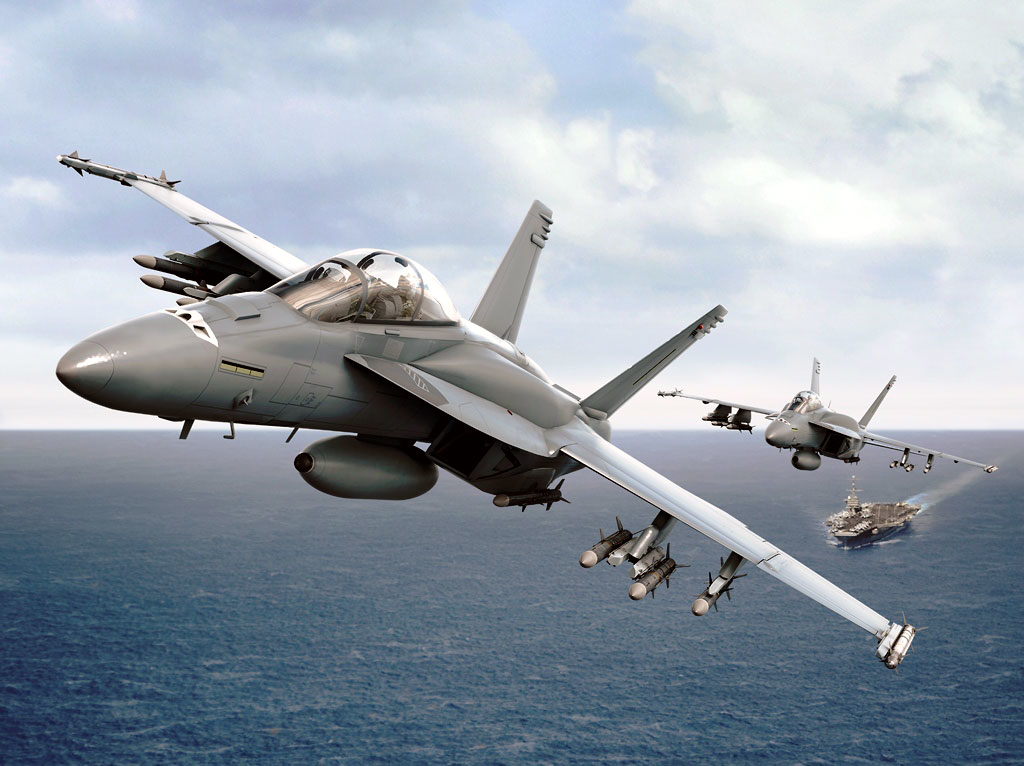
Lockheed Martin to provide infrared search and track avionics components for Navy F/A-18E/F combat jet

Brandon Thetford


infrared search and track F/A-18E/F | Military & Aerospace Electronics

IRST Block II gives the F/A-18 improved optics and processing power to improve pilot situational awareness; it will be delivered to the Navy in 2021.

John Keller

Sep 22nd, 2020
    

PATUXENT RIVER NAS, Md. – U.S. Navy air combat experts are asking electro-optics engineers at Lockheed Martin Corp. to build five infrared receivers and four control processors for the infrared search and track (IRST) system aboard F/A-18E/F Super Hornet jet fighter-bomber.

Officials of the Naval Supply Systems Command Weapon Systems Support in Philadelphia announced a $20 million sole-source order Friday to the Lockheed Martin Missiles and Fire Control segment in Orlando, Fla., to provide these IRST components. The IRST enables the F/A-18E/F to detect, track, and attack enemy aircraft in a stealthy way without making its presence known.

The Super Hornet combat aircraft IRST is a long-wave infrared detection sensors system that targets enemy aircraft in conditions where the Super Hornet cannot use its radar.

The system, which Boeing Co. Defense, Space & Security segment in St. Louis is buying from Lockheed Martin, uses infrared search and track technology to detect and provide weapons-quality track solutions on potentially hostile aircraft.

The Navy and Boeing first flew the IRST Block II pod on an F/A-18E/F Super Hornet in late 2019. IRST is a passive, long-range sensor incorporating infrared and other sensor technologies for accurate targeting.

The IRST Block II gives the F/A-18 improved optics and processing power, significantly improving pilot situational awareness, Boeing officials say. The Block II variant will be delivered to the US Navy in 2021, reaching initial operational capability shortly thereafter.

The IRST Block II is part of the Super Hornet Block III upgrades to keep the F/A-18 in active service for decades to come. Block III upgrades also include enhanced network capability, longer range with conformal fuel tanks, an advanced cockpit system, signature improvements, and an enhanced communications system.

The IRST fits on the front of the Super Hornet's centerline fuel tank. Three years ago Navy leaders approved a restructured program that foregoes full-rate production of Block I sensors and proceeds directly to the Block II system.

The IRST passive search system consists of a passive longwave infrared receiver, a processor, inertial measurement unit, and environmental control unit. The infrared receiver, processor, and inertial measurement unit fit inside the sensor, which attaches to the front of the fuel tank mounted to the aircraft on the BRU-32 bomb rack.

The Navy developed the IRST Block I using components from the F-15K/SG aircraft's infrared receiver, which is based on the IRST design of the now-retired Navy F-14 Tomcat jet fighter. IRST Block II includes improvements to the infrared receiver and updated processors. The Navy intends to produce 170 IRST systems.

Even amid electronic attack or heavy RF and infrared countermeasures, IRST provides autonomous, tracking data that increases pilot reaction time, and enhances survivability by enabling first-look, first-shoot capability, Lockheed Martin officials say.

Infrared sensors like the IRST detect the heat from an aircraft's engine exhaust or even the heat generated by the friction of an aircraft as it passes through the atmosphere. Unlike radar, infrared sensors do not emit electronic signals, and do not give away their presence to adversaries.

This ability can enable Super Hornet pilots to identify enemy aircraft at long ranges, and enable them to fire their air-to-air missiles at their maximum ranges.

Data from the IRST system can stand alone or fuse with the Super Hornet's other on-board sensor data situational awareness. Lockheed Martin also is developing an IRST pod that can be fitted to the F-15C and F-16 jet fighters.

On this contract Lockheed Martin will do the work in Orlando, Fla., and should be finished by December 2023. For more information contact Lockheed Martin Missiles and Fire Control online at www.lockheedmartin.com, Boeing Defense, Space & Security at www.boeing.com/company/about-bds, or Naval Air Systems Command at www.navair.navy.mil.


F/A-18E/F & Block III Super Hornet: Details
F-15K Slam Eagle: Details

Man vs. machine: Pentagon plans 2024 dogfight between human aircraft pilot and artificial intelligence (AI)

Neil Bates


artificial intelligence (AI) human pilot dogfight | Military & Aerospace Electronics

AI development is central to the Pentagon’s 21st-century battle plan, as global competitors pour billions of dollars into their own AI programs.

Sep 22nd, 2020
    

WASHINGTON – The Pentagon is planning a 2024 showdown between an F-16 piloted by a human and one controlled by artificial intelligence (AI), a man versus machine matchup that military officials believe could represent a key turning point in technological development. The Washington Times reports. Continue reading original article

The Military & Aerospace Electronics take:

22 Sept. 2020 -- Defense Secretary Mark Esper announced the 2024 contest during a speech on AI development earlier this month at the Pentagon. The Defense Advanced Research Projects Agency, or DARPA, already has held numerous combat simulations between a human pilot and machines.

In the most recent dogfight between AI and a human pilot, officials said the AI-controlled system easily defeated the human.

AI development is central to the Pentagon’s 21st-century battle plan. While it may be frightening to see machines top highly trained pilots, military officials argue that China and other global competitors are pouring billions of dollars into their own AI development programs, and the U.S must keep pace.

John Keller, chief editor
Military & Aerospace Electronics


Thailand buys Chinese anti-aircraft missile system FK-3

MilitaryArts


Таиланд закупает китайский зенитный ракетный комплекс FK-3 - bmpd — LiveJournal: 

Translated by google

September 21st, 23:08

According to the Thai web resource AAG , at a reporting event held in June 2020 in the 1st Air Defense Regiment of the Thai Navy, materials were presented indicating the imminent entry into service of the regiment of the new Chinese land-based mobile medium-range anti-aircraft missile system FK- 3. In particular, a stand was shown with instructions for operating the FK-3 and various materials and photographs for this complex. Launcher of the Chinese HQ-22 medium-range mobile surface-to-air missile system, the export version of which is the FK-3 complex acquired by the Thai Navy. Chkhuhai (China), November 2016 (c) Mikhail Zherdev


The conclusion of a contract for the purchase of the FK-3 air defense system for the Thai Navy was not publicly reported, but it is known that in June 2019, the Thai Navy's procurement department issued tender documents for the acquisition of a medium-range ground-based air defense system, with a maximum price of 1.97 billion baht (63.983 million USD).

It is unclear how many FK-3 complexes have been ordered (or are planning to be ordered) by the Thai Navy, but, according to the AAG resource, it is planned to purchase at least four batteries (divisions) in total, although the original contract could have been concluded for a smaller number.

In 2018, the 1st Air Defense Regiment of the Thai Navy, responsible for covering naval bases and airfields of the Thai Navy, was divided into two air defense regiments (1st and 2nd), each of which has two air defense divisions (respectively, 11th and 12th, and 21st and 22nd). Now in the armament of these air defense divisions there are only Chinese portable air defense systems HQ-18 and outdated towed anti-aircraft artillery mounts - 40-mm Bofors L / 70 and Chinese 37-mm twinned type 65 (copies of the Soviet B-47). Earlier, in the 1st Air Defense Regiment of the Thai Navy, the battery of the Chinese DK-9 short-range air defense system with towed launchers of Chinese PL-9 short-range air-to-air missiles was operated, but this system has now been removed from service in Thailand.

The Chinese FK-3 medium-range anti-aircraft missile system isan export version of the HQ-22 air defense system, which has been massively entered into service with the PLA since 2016. The HQ-22 complex itself is a further development of the well-known Chinese air defense system HQ-12 (KS-1 series) and is developed and manufactured by Jiangnan Space Industry Corporation (also known as the "061st base"), which is part of the Chinese state rocket and space China Aerospace Science & Industry Corporation Limited (CASIC). The HQ-22 air defense system uses, in particular, new anti-aircraft guided missiles in transport and launch containers.

According to the characteristics previously announced by the manufacturer, the export FK-3 air defense system has a target destruction range of up to 100 km. and the height of the defeat up to 27 km.

The line of medium-range air defense systems developed by the "061st base" is competing with the systems of two other leading Chinese manufacturers of air defense systems - a member of the same CASIC group China Changfeng Mechanics and Electronics Technology Academy (also known as the "Second Academy"), which traditionally was the lead developer of the air defense system in the PRC (in particular, the one that created the main modern Chinese air defense system HQ-9); and the Shanghai so-called "Eighth Academy" (Shanghai Academy of Spaceflight Technology), another Chinese rocket and space corporation China Aerospace Science and Technology Corporation (CASC), which produces the HQ-16 air defense system.

Earlier, in 2020, another (but, apparently, already second after the actual Thai Navy) Chinese customer SAM FK-3 made Serbia.

Also, it is worth noting that the Thai Air Force in 2016 acquired at least one division of the Chinese export medium-range air defense system KS-1CM - an export version of the HQ-12 complex, the predecessor of the HQ-22 complex. Materials on the Chinese FK-3 medium-range ground mobile anti-aircraft missile system at the reporting event of the 1st Air Defense Regiment of the Thai Navy, June 2020 (c) aagth1.blogspot.com


HQ-22 Long-range air defense missile system: Details