Tuesday, 29 June 2021

Challenger 3 battle tank to be equipped with Trophy Active Protection System

RBSL


Challenger 3 battle tank to be equipped with Trophy Active Protection System - Military Embedded Systems

June 28, 2021

EMMA HELFRICH
Technology Editor

Rafael photo.

ISRAEL. Rafael Advanced Defense Systems Ltd. announced that its Trophy Active Protection System (APS) for armored vehicles has been selected for the next phase of detailed assessment and integration by the U.K. Ministry of Defense (MoD) for the Army’s Challenger 3 MBT.

According to the company, the selection is a result of a study conducted by the U.K. MoD as part of an upgrade program led by prime contractor Rheinmetall BAE Systems Land (RBSL), which will entail detailed integration and system trials of this lighter Trophy variant (Trophy MV), to fit the particular requirements of this vehicle.

Trophy APS is designed to provide mature, combat-proven protection against rocket and missile threats while locating the origin of the hostile fire for immediate response. Trophy is a fully-integrated APS and has been installed on Israel Defense Forces’ Merkava tanks since 2010, and has also been installed on the Namer APCs. 

The company claims that Trophy has made numerous combat interceptions with no damage to platforms since its first operational interception in 2011. Trophy has accrued over 1,000,000 operating hours, including 5,400 field tests, and is now under contract for serial production of over 1,800 systems.

#####


Monday, 28 June 2021

War… It’s Just a Shot Away as Brits Provoke Russia

Peshik Yuri


FINIAN CUNNINGHAM  

THURSDAY 24 JUN 21


It sounds almost incredible that a war situation was only a shot away in such a grim face-off between NATO member Britain and Russia.

Russian patrol vessels fired warning shots at an armed British warship after it breached Russian territorial waters this week. Then a SU-24 fighter jet dropped bombs in the path of the British destroyer apparently forcing it out of Russian waters.

It sounds almost incredible that a war situation was only a shot away in such a grim face-off between NATO member Britain and Russia.

But what’s also condemnable is that the incendiary incident was a deliberate provocation by Britain. Russia has warned Britain not to provoke it again in the Black Sea. And Moscow accused London of telling barefaced lies.

The British government and its Ministry of Defense were quick to play down the incident, claiming that there were no warning shots fired on the Royal Navy guided-missile destroyer. London accused Russia of “disinformation” and maintained that HMS Defender was engaged in “innocent passage” through international waters in the Black Sea.

However, the official British version is contradicted by a BBC correspondent who was on board HMS Defender.

Jonathan Beale reported: “I am on board the warship in the Black Sea.The crew were already at action stations as they approached the southern tip of Russian-occupied [sic] Crimea. Weapons systems on board the Royal Navy destroyer had already been loaded.

This would be a deliberate move to make a point to Russia. HMS Defender was going to sail within the 12 mile (19km) limit of Crimea’s territorial waters. The captain insisted he was only seeking safe passage through an internationally recognized shipping lane.”

Thus, according to the BBC’s account, a fully armed and cocked warship deliberately entered territorial waters claimed by Russia (since Crimea joined the Russian Federation by a referendum in 2014). The crew were at action stations on their approach “to make a point to Russia”.

Such conduct by the British is nothing less than a wanton provocation to Russia. The BBC version concurs with Russia’s account of the circumstances, including the sound of warning shots.

One question is: why did the British government and MoD seek to immediately play down the incident, purporting to say that nothing had happened? London claimed that the warship was merely in the vicinity of Russian “gunnery exercises” as if it was all coincidence and that Moscow was engaging in disinformation about warding off the Royal Navy vessel.

Another question is: why was the BBC correspondent invited to take part in the Black Sea voyage of HMS Defender from the Ukrainian port of Odessa to Georgia skirting the Crimea Peninsula? It seems like the British may have been expecting their “point to Russia” would have been met with a passive response. And so the British would have been able to spin that their plucky navy was able to stick it to the Russians. Turns out though that the BBC man unhelpfully contradicted the military planners in London.

Britain was obliged to deny the military encounter because it knows full well that it was a provocative show of aggression by its warship. If the shots had escalated it could have been an act of war that Britain had instigated. Aggression is the supreme war crime as defined by the Nuremberg trials of Nazi leaders.

Russia has condemned the British action, saying HMS Defender should be renamed HMS Aggressor or HMS Provocateur.

It is also reported that on Tuesday, the day before the skirmish, Ukrainian military chiefs were hosted onboard HMS Destroyer while docked in Odessa where they signed new military contracts with the British on naval cooperation. That the Brits then sailed the next day straight into Russian waters suggests that the maneuver was a calculated show of naval power in support of Ukraine’s claims of “fighting against Russian aggression”.

As far back as April, the British had given notice that they were intending to dispatch warships to the Black Sea “in support of Ukraine”. Russia responded angrily and warned Britain and other NATO members to stay away from its territory. Russia subsequently has deployed larger military forces in its Black Sea territory, including around the Crimea Peninsula.

That the British went ahead with their plans to send warships into disputed waters is further sign that London was deliberately goading Moscow.

What the Brits were not expecting, it seems, was the way Russia rapidly deployed firepower this week to underscore its warnings to back off.

This is the context for why international “stability talks” between the United States and Russia are an urgent matter. It remains to be seen if the American Biden administration genuinely responds to Moscow’s appeals for earnest negotiations to stabilize relations. NATO so far seems to be indifferent to Russian proposals for cooperating on forming new security mechanisms in Europe.

The deterioration in relations between Russia and the United States and other NATO members has reached a dangerous flashpoint. The arming by the U.S. and NATO of the anti-Russia regime in Kiev is fueling the potential for all-out conflict between nuclear powers. Western indulgence of Kiev’s reckless claims of “Russian aggression” is further insanity.

And amid the treacherous conditions, the British send a guided-missile destroyer into Russian waters in defiance of reasonable warnings. That’s just a shot away from disaster.

Incredibly, this is all happening on the 80th anniversary of Operation Barbarossa when Nazi Germany launched its war against the Soviet Union on June 22, 1941.

Source thealtworld.com

#####


Type 45 Daring Class: Details
Su-24M Fencer: Details

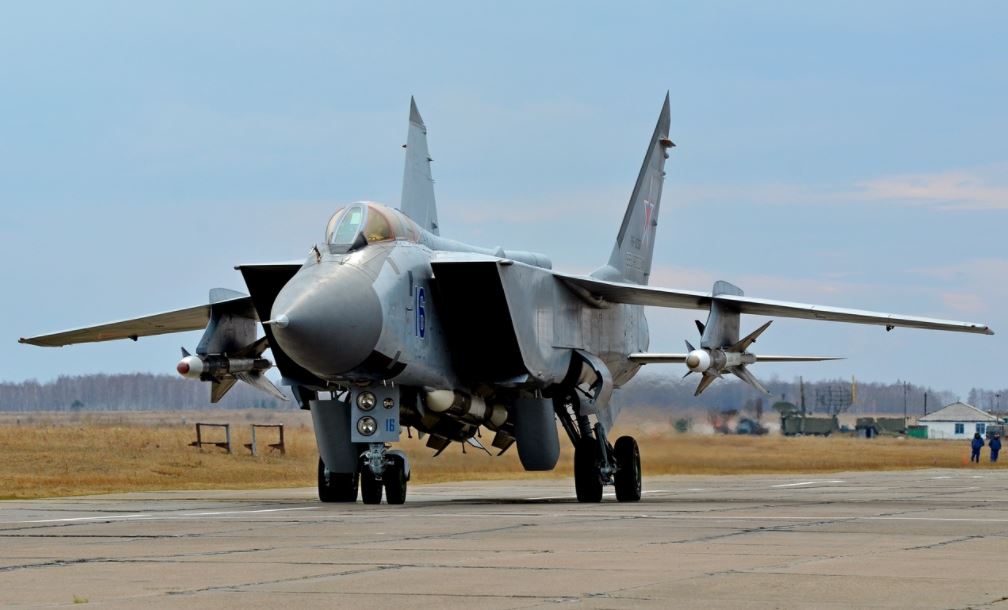
Military Watch: Russian MiG-31K fighters sent to Syria with two important missions

Max C


Military Watch: Российские истребители МиГ-31К отправлены в Сирию с двумя важными задачами - discover24.ru

Date: June 27, 2021

AUTHOR Vadim Botnaryuk

The deployment of heavy MiG-31K fighters at the Russian Khmeimim airbase in Syria serves not only as a response to the deployment of a joint British and American carrier strike group in the Eastern Mediterranean, but also aims to familiarize the Syrians with the management of modern combat aircraft, which could ultimately be selected by the Syrian Air Force for replacing the aging MiG-25. This is reported by the American military edition Military Watch. We present the translation of this article.

After expanding the runways in 2020, the Russian Air Force deployed MiG-31K (Foxhound) heavy combat aircraft at Khmeimim airbase in Syria, its most active military facility outside the former USSR. This follows the first-ever deployment of Tu-22M supersonic bombers at the same facility in May, with longer runways being the key to deploying such aircraft.

Russian state media dubbed the MiG-31K interceptors and showed footage of them flying unarmed with Kh-47M2 hypersonic ballistic missiles, indicating that they can use air-to-air missiles as well as long-range R-missiles. 37. The interceptor variants MiG-31, MiG-31BM and MiG-31BSM are considered the most capable aircraft of the country in terms of the ability to attack air targets deployed at the squadron level.

Earlier it was reported that Syria showed interest in acquiring these aircraft, which are valued for their unrivaled speed and range, as well as for the very high degree of situational awareness provided by their Zaslon-M radars.

The MiG-31K entered service in 2018 and, along with the Tu-22M, is one of two aircraft in the Russian Air Force capable of carrying the Kh-47M2 hypersonic missiles. This rocket model has no competitors outside of Russia, it is distinguished by very high accuracy, a speed of Mach 10 and a flight range of 2000 km. Missiles are prized for their ability to hit both warships and ground targets, as well as their ability to carry both conventional and nuclear warheads. Their speed, combined with their high maneuverability, makes them virtually inaccessible to interception.

The Khmeimim airbase was established in August 2015, shortly before the Russian military intervention in Syria, and initially deployed aircraft needed to support Syrian counterinsurgency activities, such as Su-25 attack aircraft and Su-24 strike fighters. Since November 2015, they have been reinforced by air superiority fighters such as the Su-27SM3 and later the Su-35.

More recently, with the final decision on the outcome of the Syrian war, Russia has deployed longer-range weapons systems that enable it to strike targets across Europe from NATO's more vulnerable southern flank. The high endurance and very long range of the Tu-22M and MiG-31 - two of the heaviest combat aircraft ever used in Hemeimim - make them ideal for such missions.

The deployment of the MiG-31K follows the deployment of a joint British and American aircraft carrier strike group in the Eastern Mediterranean off the coast of Syria and comes amid a surge in tensions between Moscow and London. The official statement said that the Foxhounds "have begun to carry out tasks to develop the airspace of the region", which indicates their role not only in air strikes against ground targets.

The deployment of the MiG-31K can serve additional purposes: in particular, to familiarize the personnel of the airbase with combat aircraft of this type, in order to prepare the possibility of receiving and servicing a larger number of Foxhounds, and in the long term - potentially also to familiarize the Syrians with the management of modern combat aircraft, which may ultimately be chosen to replace the aging MiG-25 (Foxbat), currently the elite of the Syrian Air Force.

#####


Sunday, 27 June 2021

New missile and artificial intelligence technologies will turn Tu-160 into a "doomsday weapon"

Ilya Boldyrev


Author Vadim Botnaryuk

June 24, 2021 05:33

The bomb compartment of the Tu-160 "White Swan" strategic missile carrier will receive the latest missile, which has no analogues today in any country in the world.

This rocket is being built in complete secrecy. The technologies for its development and production are not disclosed at the moment. However, experts believe that the basis for a new type of weapon will be Zircon hypersonic missiles capable of accelerating to Mach 9 or 11 thousand kilometers per hour.

In addition, the next modernization of the Tu-160 implies the installation of the latest electronics, controlled by artificial intelligence. The American media have already noted the efforts of the Russian designers and said that the upgrades of the bomber make it a "doomsday plane."

Recall that the day before the Russia-US summit in Geneva, publications appeared in the United States about the appearance of the Tu-160 near the Hawaiian Islands in the Pacific Ocean. The US Air Force even sent its F-22 fighter to intercept, but the bomber managed to return to its place of permanent deployment even before its appearance.


Tu-160 Blackjack: Details
3M22 Zircon: Details

U.S. State Dept OKs possible sale of F-16s, missiles to Philippines

US Air Force / Staff Sgt. Trevor T. McBride


David Brunnstrom
Mike Stone

U.S. Army soldiers look at an F-16 fighter jet during an official ceremony to receive four such aircraft from the United States, at a military base in Balad, Iraq, July 20, 2015. REUTERS/Thaier Al-Sudani/File Photo


WASHINGTON, June 24 (Reuters) - The U.S. State Department has approved the potential sale of F-16 fighter jets, as well as Sidewinder and Harpoon missiles, to the Philippines in three separate deals with a combined value of more than $2.5 billion, the Pentagon said on Thursday.

The Philippines is looking for a new multi-role fighter jet and is evaluating the F-16 and the SAAB Abs (SAABb.ST) Gripen.

The announcement comes as the United States seeks to renew an agreement with the Philippines governing the U.S. troop presence in the country, which is critical to Washington’s strategy to counter ever-expanding Chinese activity in Asia.

Last week, the Philippines again suspended for another six months a move to scrap the two-decade-old Visiting Forces Agreement (VFA) that had been due to expire in August. read more

The Pentagon said the Philippines requested to buy 10 F-16C Block 70/72 aircraft and two F-16D Block 70/72 aircraft made by Lockheed Martin Co (LMT.N). That package, which includes spares and training, is valued at up to $2.43 billion.

Despite the State Department approval, the notification does not indicate that a contract has been signed or that negotiations have concluded. Often during a competition, the department will approve exports before a winner is named.

Eric Sayers, a visiting fellow at the conservative American Enterprise Institute, said it appeared to be "a proactive effort by Washington to ensure the United States remains the security partner of choice for Manila."

Philippines President Rodrigo Duterte, who has frequently condemned U.S. foreign policy while exploring closer ties with China, told Washington last year he was canceling the VFA amid outrage over a senator and ally being denied a U.S. visa. But he has repeatedly suspended the expiration date.

Gregory Poling, maritime security expert at the Center for Strategic and International Studies, said one of Duterte’s complaints has been his perception that the United States does not provide high-quality equipment to the Philippines.

"I’d expect that the U.S. government will be looking for opportunities over the next six months to combat that perception," he said.

The Pentagon also notified Congress on Thursday of the possible sale of two missile packages to the Philippines.

One was for 12 Harpoon Air Launched Block II Missiles, two training missiles, spares and equipment made by Boeing (BA.N) and valued at up to $120 million.

Another was for 24 AIM-9X Sidewinder Block II tactical missiles, 24 training missiles and spare parts made by Raytheon Technologies (RTX.N) and valued at up to $42.4 million.

The Philippines is a U.S. treaty ally and several military agreements are dependent on the VFA, which governs the rotation of thousands of U.S. troops in and out of the Philippines.

Having the ability to rotate in troops is important not only for the defense of the Philippines, but strategically for the United States when it comes to countering China's increasingly assertive behavior in the region.

"The package is a serious step that will certainly get Beijing's attention," said Sayers.

Lockheed Martin said the F-16 would play a significant role in strengthening Manila's strategic partnership with Washington and allies, while enabling the Philippines to join other Southeast Asian F-16 operators.

Reporting by Mike Stone in Washington


Saturday, 26 June 2021

Russia’s Defense Ministry to deliver four Su-57 fighters this year

Alexei


Thursday June 17, 2021 14:46 MSK

© Alexey Kondratov

Russia’s Defense Ministry will receive four Su-57 fifth-generation fighters this year, Russian Deputy Prime Minister Yuri Borisov said during his visit to the Gagarin Aviation Plant in Komsomolsk-on-Amur in Russia’s Far East on Wednesday.

"This year, 15 combat planes are due to be delivered [by the Gagarin Aviation Plant] to the customer and under export contracts. As you know, the Defense Ministry has signed a large long-term contract on the Su-57, and this year four serial-produced planes will be delivered. The production of generation 4++ Su-35 planes continues," the vice-premier said.


Friday, 25 June 2021

Malaysia to buy new fighters in tense territorial situation

Gilles Denis


on 23rd June 2021

CLEMENT CHARPENTREAU

Image : hkhtt hj/Shutterstock

The Malaysian government issued an international tender on June 22, 2021, for the Royal Malaysian Air Force (RMAF) Light Combat Aircraft/Fighter Lead-In-Trainer (LCA/FLIT) program.

The Ministry of Defense intends to acquire 18 FLIT/LCA aircraft. The tender will close on September 22, 2021. The light fighters will replace several aging aircraft, such as the BAe Hawk Mk 108 and Mk 208, and support the Boeing F/A-18D Hornet and Sukhoi Su-30MKM in service with the RMAF. As for the trainers, they will replace the Aermacchi MB-339CM trainer jets that are currently grounded. The proportion would be 8 trainers for 10 light combat aircraft, according to an industry source quoted by Janes.

Malaysia recently retired the MiG-29 Fulcrum due to its inability to maintain them. Since then, the RMAF has in dire need of aircraft capable of carrying out an interception. A similar tender had already been issued in 2018. It received proposals from several international manufacturers, including the Korea Aerospace Industries (KAI) FA-50, India’s HAL Tejas, the Leonardo M-346, and the Boeing T-X, since renamed T-7 Red Hawk. Due to a lack of funding, the competition did not go forward.

However, the capability gap was most likely felt very recently by the Malaysian authorities. On May 31, 2021, RMAF Hawks from the Labuan Air Base intercepted a tactical formation of no less than 16 Chinese transport aircraft that came within 110 kilometers (60 nautical miles) from Sarawak, a Malaysian state on the island of Borneo. Foreign Minister Hishammuddin Hussein issued a formal complaint to China, which minimized the incident, saying that the aircraft that were in training at the time “strictly abided by the relevant international law.”

Situated on the southwestern side of the tumultuous South China Sea, Malaysia has ongoing territorial disputes with its neighbors over the control of some of the Spratly Islands. The Swallow Reef, for example, that it controls since 1983 with a base of the Royal Malaysian Navy, is also claimed by Vietnam, Taiwan, and China.