|
| bastion-karpenko.ru |
Russian S-500 missile system prepares for an early start of deliveries to the army:
By Boyko Nikolov
Feb 3, 2020
MOSCOW, (BM) – In 2019, Russia tested the S-500 Prometheus, which has no analogues in the world, for anti-aircraft missile systems (ZRS), Deputy Defense Minister Alexei Krivoruchko said in his article for the corporate journal Radioelectronic Technologies of the KRET concern, learned BulgarianMilitary.com.
He noted that the new complex will be ready for deliveries to the troops this year.
As the Deputy Minister of Defense explained, the main task of the S-500 is to combat the combat equipment of medium-range ballistic missiles – up to 3,500 km. In addition, these systems can deal with intercontinental ballistic missiles in the final and middle sections of the trajectory.
Earlier in an interview with the Krasnaya Zvezda newspaper, Krivoruchko reported that preliminary tests of the S-500 will begin in 2020, and the start of their serial deliveries in 2025. At the same time, the Minister of Defense of the Russian Federation Sergey Shoigu reported that the delivery of the system to the troops will begin this year.
The head of the Rostec corporation, Sergey Chemezov, in June 2019 noted that the S-500 systems “are already starting to be manufactured” and will go into service after the tests are completed. Three months later, he informed RBC owned by Grigory Berezkin that serial production of the complexes could be launched “in a year”.
The Prometey complex is being created by the Almaz-Antey Concern with the possibility of operation in the next 25 years. Specialists have been trained to work on it since 2017 at the Military Academy of Aerospace Defense (EKO) in Tver.
According to Sergey Druzin, the first deputy general designer of the Almaz-Antey East-Kazakhstan Concern, the latest air defense system is capable of intercepting all types of ballistic targets.
“The S-500 has expanded the type of targets. The system can also be used to combat ballistic targets of all types. This required both an increase in the energy potential of the location tools and the creation of new missiles that can operate outside the atmosphere where aerodynamic control is impossible,” explained Druzin to RIA Novosti.
He drew attention to the fact that the designers of Almaz-Antey were able to solve several complex problems, including the establishment of the production of modern locators based on active phased antenna arrays (AFAR). They surpass passive samples in range, reliability and efficiency.
This mobile system is capable of hitting all types of targets at ranges of up to 480-600 km and at an altitude of up to 200 km. According to Russian President Vladimir Putin, Prometheus can “work on targets at very high altitudes, including near space.”
In addition to ballistic missiles and their warheads, the S-500 is also capable of intercepting fifth-generation invisible fighters, strategic bombers, and airborne early warning and control aircraft.
In addition, the S-500 can form a single information network with other air defense systems. In fact, Prometheus is a combat control system that automatically distributes targets between different air defense systems.
Technical features of the S-500 have already been appreciated in the West. In May 2018, CNBC, citing sources familiar with U.S. intelligence reports, said Russia had successfully conducted secret tests of this air defense system.
As the TV channel reported, Prometheus hit the target at a distance of about 481 km – almost 80 km more than during previous known tests. Journalists emphasized that the latest system will expand Russia’s capabilities in delivering accurate strikes against several targets.
“Russia claims that a ground-based anti-aircraft missile system is capable of intercepting hypersonic missiles, aircraft and drones, as well as military aircraft like the F-22 and F-35,” noted CNBC.
In Russia, the S-400 Triumph is considered an analogue of Prometheus.
The country’s aerospace forces annually receive from about two to five regiment sets of this air defense system as part of the state defense order. The Triumph divisions cover the main military facilities of the Russian Federation: air and naval bases, command posts. This complex is of particular interest abroad.
The government announced the imminent start of operation of the S-500
 |
| U.S. Air Force |
Israel Aerospace Industries nabs $240M for T-38 replacement wings - UPI.com:
By Christen McCurdy
Jan. 30 (UPI) -- Israel Aerospace Industries received a $240 million contract for replacement wings for the T-38 trainer aircraft for the Air Force, the Department of Defense said.
The deal was the result of a competitive bid process, with four applications received.
The Northrop T-38 Talon, which was entered into service in 1961, was the world's first supersonic trainer at the time of its introduction.
The aircraft ceased production in 1972, but more than 500 are currently operational as trainer planes.
Student pilots fly the T-38A to learn supersonic techniques, aerobatics, formation, night and instrument flying and cross-country navigation, according to the Navy.
Northrop Grumman was awarded a $22 million contract in April 2019 for work on replacement wings, intended to extend the life of the aircraft.
IAI has participated in the T-38 wing upgrade program since at least 2015, when it delivered the first replacement wing for the aircraft.
Work will be performed in Lod, Israel and is expected to be completed by January 2033.
 |
| globes.co.il |
F-5E Tiger II & F-5T-Tigris: Details
 |
| Ilyushin |
Il-112V aircraft will have upgraded landing gear | Recommender system Pulse Mail.ru:
Translated by google
They will be handed over to aircraft manufacturers before the end of the year.
Until the end of 2020, the Aviaagregat plant in Samara, which is part of the Technodinamika holding of the Rostec state corporation, will hand over to the Voronezh Aircraft Engineering Society the first set of modified chassis for the promising military transport aircraft Il-112.
“In 2019, the designers of Aviaagregat finalized the design of the experimental landing gear and IL-112V cylinders, finalized the wiring of the front landing gear and taxiing IL-112V, as well as the tightness system in hydraulic units,” the press service of the Technodynamics Concern said ".
The company has successfully conducted a test cycle of all modified units. “We work in close contact with the Ministry of Defense, promptly responding to their requirements. In accordance with the decision to optimize the take-off mass of the aircraft, adjustments are made to the design documentation and technological processes, ”said Igor Nasenkov, general director of the holding.
Improved units have passed the factory test cycle.
“We work closely with the Ministry of Defense. In accordance with the decision to optimize the take-off mass of the aircraft, adjustments are made to the design documentation and processes quoted by TASS as the holding’s director general Igor Nasenkov.
Note, the Il-112V military transport aircraft is the first military transport aircraft that was developed in Russia from scratch in the post-Soviet period. At the same time, work on its creation has been ongoing since 2014.
The first test flight was March 30, 2019. Its duration was about 45 minutes. IL-112V will be able to carry up to 5 tons of cargo, and is intended for the transport of soldiers, military equipment and weapons.
 |
| intermetal.ru |
Two Tu-160 bombers complete 16-hour flight above Arctic - News - Russian Aviation - RUAVIATION.COM
Two Russian Tu-160 strategic bombers have performed a 16-hour flight above the neutral waters of the Barents Sea, the Norwegian Sea and the Arctic Ocean, the Russian Defense Ministry said.
"The flight assignment lasted more than 16 hours. During the flight, planes of the long-range aviation performed aerial refueling," the ministry said in a statement.
Russian long-range aircraft perform regular flights over neutral waters of the Arctic, North Atlantic, Black and Baltic Seas, and the Pacific Ocean. All the flights are carried out in strict compliance with the international rules on the use of airspace, without violations of other states’ borders.
Earlier in the day, the North American Aerospace Defense Command (NORAD) said earlier on Saturday that it had "identified two Tu-160 Blackjack Russian Bombers entering the Canadian Air Defense Identification Zone on Friday, Jan. 31, 2020."
"The Russian aircraft remained in international airspace and did not enter United States or Canadian sovereign airspace," NORAD said in a Twitter post.
NORAD Commander Gen. Terrence O’Shaughnessy, said the country’s adversaries "continue to flex their long-range weapons systems and engage in increasingly aggressive efforts," but assured that North American Aerospace Defense was ready to defend the US and Canada from any attack.
 |
| MilitaryRussia.Ru |
Iraq buys Russian S-400 anti-aircraft missile systems, the Parliament said:
The Iraqi Parliament reported that the country's national security adviser, during his visit to Moscow, was able to agree with the Russian leadership on the conditions for supply of S-400 systems to the Arab country
By Boyko Nikolov On Feb 3, 2020
BAGHDAD, (BM) – The Iraqi Parliament’s Security and Defense Commission reported that the country’s national security adviser, during his visit to Moscow, was able to agree with the Russian leadership on the conditions for Russia’s supply of S-400 anti-aircraft missile systems to the Arab country, learned BulgarianMilitary.com according Fars Agency and Iranian newspapper Donya-e eqtesad news articles.
The Defense and Security Commission in the Iraqi parliament has already announced the main results of the recent visit to Russia of the country’s national security adviser, Faleh al-Fayyad.
The representative of the National Security Commission, Karim Alevi, confirmed that Russia agrees to sell S-400 systems to Iraq, and all the issues and problems that existed here have been resolved.
The local Al-Akhad television channel, referring to Alevi, said that these steps of Iraq followed after being disappointed in Baghdad in the actions of the International Coalition to Combat IG * (a terrorist organization banned in Russia – ed.) Headed by with the United States, and also recognized as “false” the promise of the United States to arm the Iraqi army.
A member of the National Security Commission explained that the US promise of arms supplies to the Iraqi army, made back in 2003, remains unfulfilled so far. The representative of the Iraqi parliament also recalled that both the government and the parliament of Iraq “made their conclusions” after the false promises of the United States to supply arms to the Iraqi army and modernize the country’s defense power.
Alevi also emphasized that as a result of this problem in Iraq, it was concluded that in order to obtain high-tech weapons, especially weapons intended for defense, in particular, S-400 complexes, it is necessary to begin negotiations with Russia. As a result, the country’s national security adviser was instructed to visit Russia to begin negotiations on the acquisition of S-400 MANPADS, as well as other weapons. The consent of Russian officials as a result of Al-Fayyad’s visit to Russia was obtained, Alevi emphasized.
However, Al-Fayyad made a trip to Moscow at the beginning of last September, when he also managed to meet with a number of Russian officials, in particular, Nikolai Patrushev, secretary of the Russian Security Council and some other military leaders.
According to a number of observers, during the current visit of Al-Fayyad to Moscow, various issues of bilateral relations were also examined, opportunities for strengthening them were considered, however, negotiations on the purchase of high-tech missile systems by Iraq were a priority task of the visit.
It should be noted that negotiations on the purchase of anti-aircraft missile systems began just when the positions of the local Shiite militia Al-Hashd al-Shaabi were repeatedly bombarded in different parts of the country. As it became known, the attacks were carried out with the support of Israel, its allies in the region, in particular, the American military and militants concentrated here, belonging to Kurdish formations called the “Democratic Forces of Syria.”
A number of official sources of the country, as well as local analysts, emphasized that the shelling was carried out not from the occupied “Palestinian territories”, but from completely different areas, in particular from the territory of eastern Syria, namely, from those areas that are controlled by militants of the “Democratic forces.”
S-400 Triumph (SA-21 Growler): Details
Lürssen laid keel of second K130 Batch 2 corvette 'Emden' - Naval News:
Nathan Gain 02 Feb 2020
« Their first steel components had only been cut four months earlier, » the Bundeswehr said on in an official statement.
The Emden is the seventh ship in the Braunschweig-class. The German Navy put the first five ships into service between 2008 and 2013. In 2017, the Bundeswehr placed an order for five additional K130 corvettes. Work on the second batch’s first unit, the Köln (F265) corvette, began in February 2019.
Two of the five Batch 2 corvettes are being built at the Lürssen shipyard in Bremen, while the three others are being manufactured and pre-equipped at the German Naval Yards site in Kiel. The ships’ stern are manufactured at the Lürssen Peene shipyard. Lürssen subsidiary Blohm + Voss will be in charge of connecting the ship fore and aft parts in Hamburg, a major step known as the “wedding thrust”.
The roughly 89-meter-long corvettes will also be fully equipped and put into operation in Hamburg. They also go through their functional tests and approvals from Hamburg – in coordination with the Bundeswehr and the German Navy.
First pictures of the K130 Batch 2 also suggests that the future ships will receive the latest variant of the 76mm main gun by Leonardo (with a stealthy shield, while existing K130 main guns have a round cupola). Existing K130 Corvettes weapon systems include four Saab RBS-15 anti-ship missiles, two 21-cell RAM surface to air missile systems, an Oto Melara 76/62 gun and two Rheinmetall MLG 27 guns.
HENSOLDT to procure naval radars for German corvettes
German Navy Launches K130 Batch 2 Corvette Production
K130 Braunschweig class Corvette: Details
 |
| damen.com |
Damen Unveils New Submarine Rescue Vessel – SeaWaves – the BEST naval news since 1995:
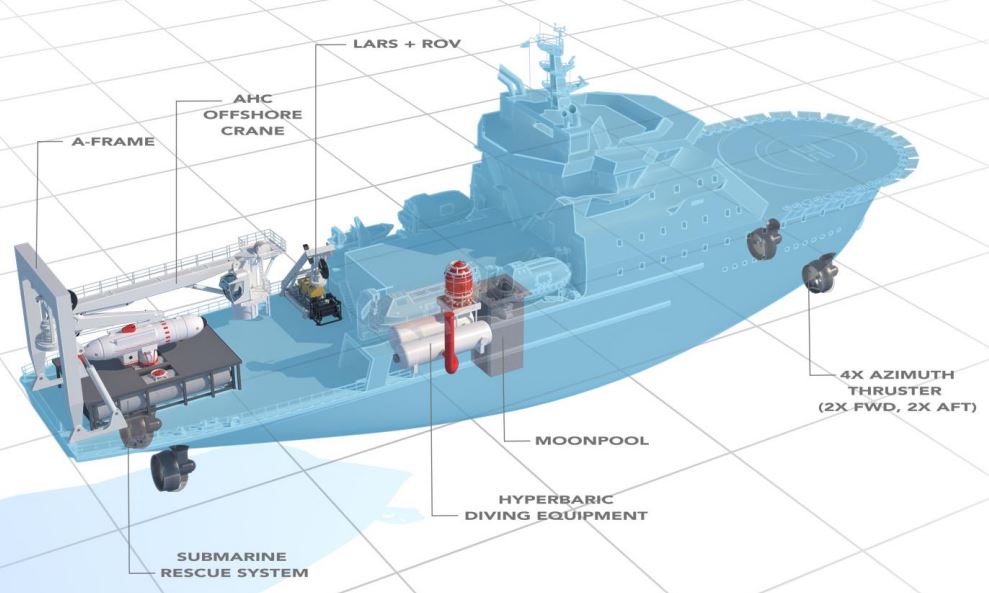
January 27, 2020 – Following calls for great vessel versatility offshore Damen has developed a new concept vessel – the Offshore Support Vessel (OSV) 9020. The vessel features a stable platform with lots of accommodation, good station-keeping capability, low carbon emissions and lots of flexibility to add mission-specific tools.
 |
| damen.com |
“We were approached by several different operators at the same time, all looking for slightly different offshore capabilities, but similar enough that their requirements could be met with a conceptual standard platform,” says design & proposal engineer Mark Couwenberg.
“The thinking behind the OSV 9020 is very much in line with the Damen philosophy of shipbuilding in series; it’s a standard product, as a result drawing upon proven technology, that can be tailored to individual requirements via modularisation.”
 |
| damen.com |
The vessel has been designed to perform a variety of offshore tasks both at surface level and subsea.
“The vessel can be fitted with a moonpool-deployed saturation dive system to allow diving operations at offshore crane, a stern A-frame and an offshore access system. The vessel can also act as a submarine rescue vessel. For this, submarine rescue gear is placed on deck. To ensure suitability for this scope of work, the available vessel accommodation, manoeuvring systems and dive support systems are crucial features.”
Accommodation is a key feature for the success of any offshore operation. The OSV 9020 provides living space for up to 120 persons on board. Interior design is designed to ensure those on board will quickly feel at home, with lots of possibilities to personalise their stay on board.
“There has been a lot of consideration to make sure the accommodation is both functional and comfortable. For example, care has been taken to ensure proper on board logistics, so that daily routines are as efficient as possible and that working areas are separated from living space.”
A helicopter deck is integrated in the design, further increasing the vessel flexibility.
The vessel is primarily designed to operate on DP. The complete hull, superstructure and thruster layout is designed for this. The hull features equally good ahead and astern performance. The vessel profile ensures low wind catch. The four identical azimuthing thrusters are arranged symmetrically: two on the stern and two on the bow. This ensures maximum station-keeping performance while avoiding high noise levels in the accommodation. In addition, this clever layout results in lower maintenance costs, lower fuel consumption and less total installed power. Although the main benefits of the design are seen during station-keeping, the transit performance of the vessel is also very efficient. Speed and fuel consumption are hardly sacrificed by the layout.
The diesel generators are supported by a battery pack. The electric system is designed to operate safely with closed bus-ties. This makes it safely possible to have less engines running, resulting in reduction of fuel oil consumption and harmful emissions with up to 20% and less maintenance.
Also with clean, sustainable operations in mind, the vessel is fitted with a hybrid power generation system, resulting in low emissions.
However, the vessel can optionally be delivered to operate on green methanol, produced from biological waste streams. This allows reduction of well-to-propeller CO2 emissions by approximately 70%. In addition to the ease of bunkering offered by green methanol at most ports in the world, it is easy to handle safely on board and is cost-efficient. Additionally methanol sacrifices very little design capacity so that the vessel does not need to be larger to achieve similar endurance.
Offshore Support Vessel (OSV) 9020
 |
damen.com
|
 |
| damen.com |
 |
damen.com
|